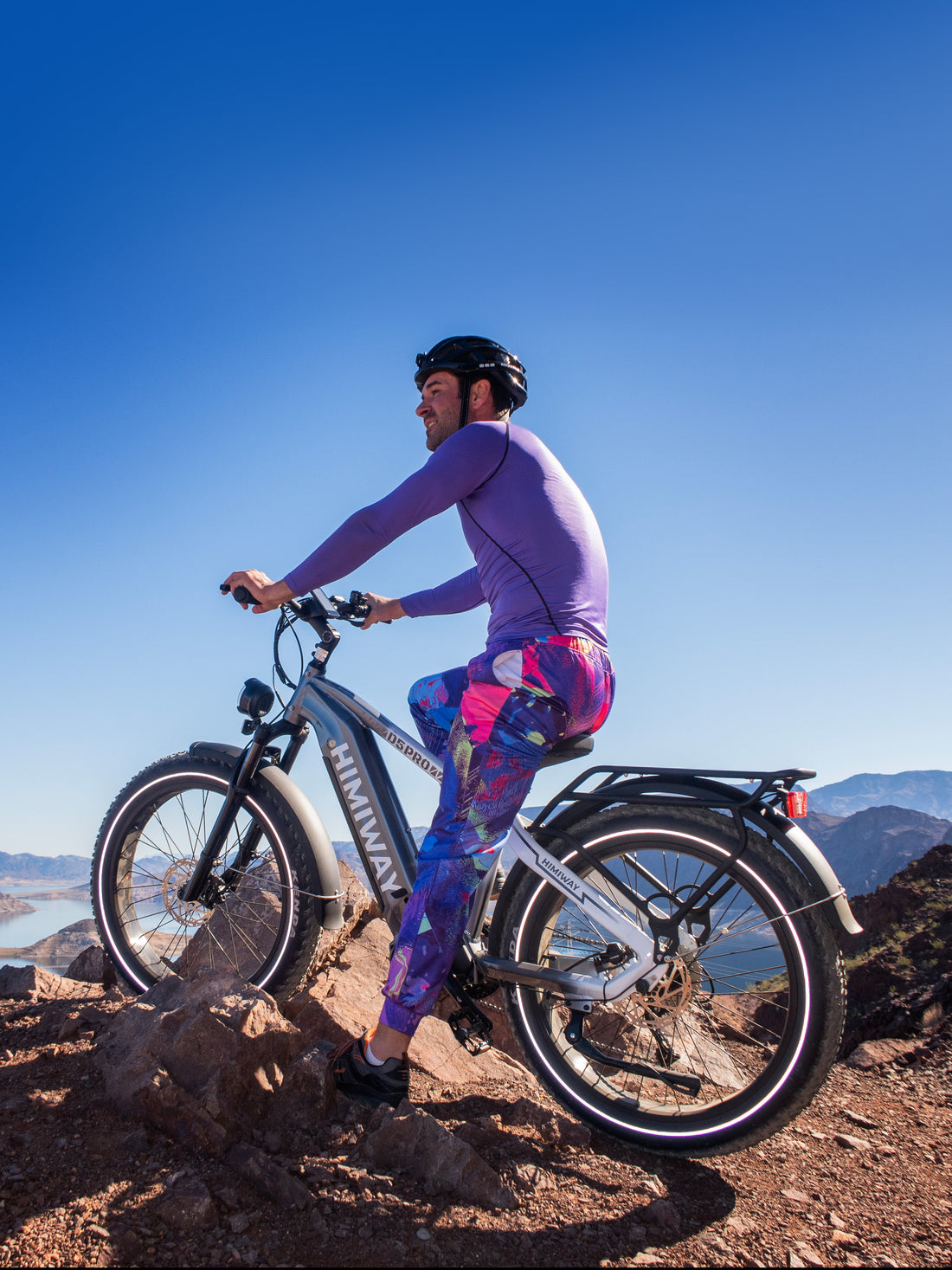
best off-road electric bike for adults

best off-road electric bike for adults

1000+Shop

2-Year Warranty

15-Day Trial

Free Shipping

Best Off-Road Electric Bikes Guide

Expert-selected off-road e-bikes built for trails, hunting, and all-terrain adventures — with the power, range, and durability adult riders demand.

What Makes a Great Off-Road Electric Bike

🏔️ Built for Real Trails

  • Fat tires (4.0"–4.8") grip loose gravel, mud, sand, and snow where standard tires slip and slide
  • Full suspension absorbs roots, rocks, and ruts at speed — 100mm to 220mm of travel depending on how aggressive your terrain gets
  • Reinforced 6061 aluminum frames with 400 lb total capacity handle rider weight plus gear without flex
  • Hydraulic disc brakes (180mm–203mm rotors) provide reliable stopping power on steep descents and wet surfaces

⚡ Power That Matches the Terrain

  • 750W hub motors (86–90Nm) handle moderate trails, gravel roads, and weekend off-road adventures
  • 1000W mid-drive motors (160Nm) multiply torque through the gears for steep climbs and technical single-track
  • Torque sensors match motor output to your pedaling effort — push harder uphill, the motor responds proportionally
  • Shimano 8-10 speed drivetrains let you find the right gear for any grade, from flat fire roads to 20%+ inclines

🔋 Range for All-Day Adventures

  • 720Wh to 960Wh batteries deliver 60-80 miles on pedal assist — enough for full-day trail rides without range anxiety
  • UL2271 certified Samsung/LG cells with UL2849 whole-bike certification for safe, long-lasting performance
  • Pedal assist extends range roughly 60% over throttle-only riding: the D5 2.0 gets 65 miles on PAS vs 40 miles on throttle
  • Switchable Class 1/2/3 settings let you ride trails (Class 1, 20mph) and roads (Class 3, 28mph) on the same bike

Top 3 Off-Road Electric Bikes

🏆 Best All-Terrain Off-Road

Himiway D5 2.0

Full suspension with 100mm front RST fork and 130mm rear multi-link travel. Switchable torque/cadence sensor adapts to any trail condition. Maxxis 26x4.0" fat tires with EXO sidewall protection handle gravel, dirt, and mud.

750W 90Nm | 720Wh | 65mi | 400lb capacity

🦌 Best for Extreme Off-Road & Hunting

Himiway D7 Pro

Bafang M620 1000W mid-drive with 160Nm torque and four-bar linkage suspension (220mm front + RockShox rear). CST 26x4.8" ultra-wide tires — the largest in the US e-bike market. Forbes calls it "a great all-around bike."

1000W 160Nm | 960Wh | 60-80mi | 400lb capacity

🌲 Best Stealth Off-Road

Himiway D5 2.0 Camo

Same proven D5 2.0 platform with seamless nature camo wrap, step-through frame for easy mounting with gear, and 1,000 lb towing capability. Quiet motor operation for hunting and wildlife photography.

750W 90Nm | 720Wh | 65mi | 1,000lb towing

Off-Road Electric Bike FAQ

Answers to the real questions riders ask before buying an off-road e-bike — from trail selection to hunting applications.
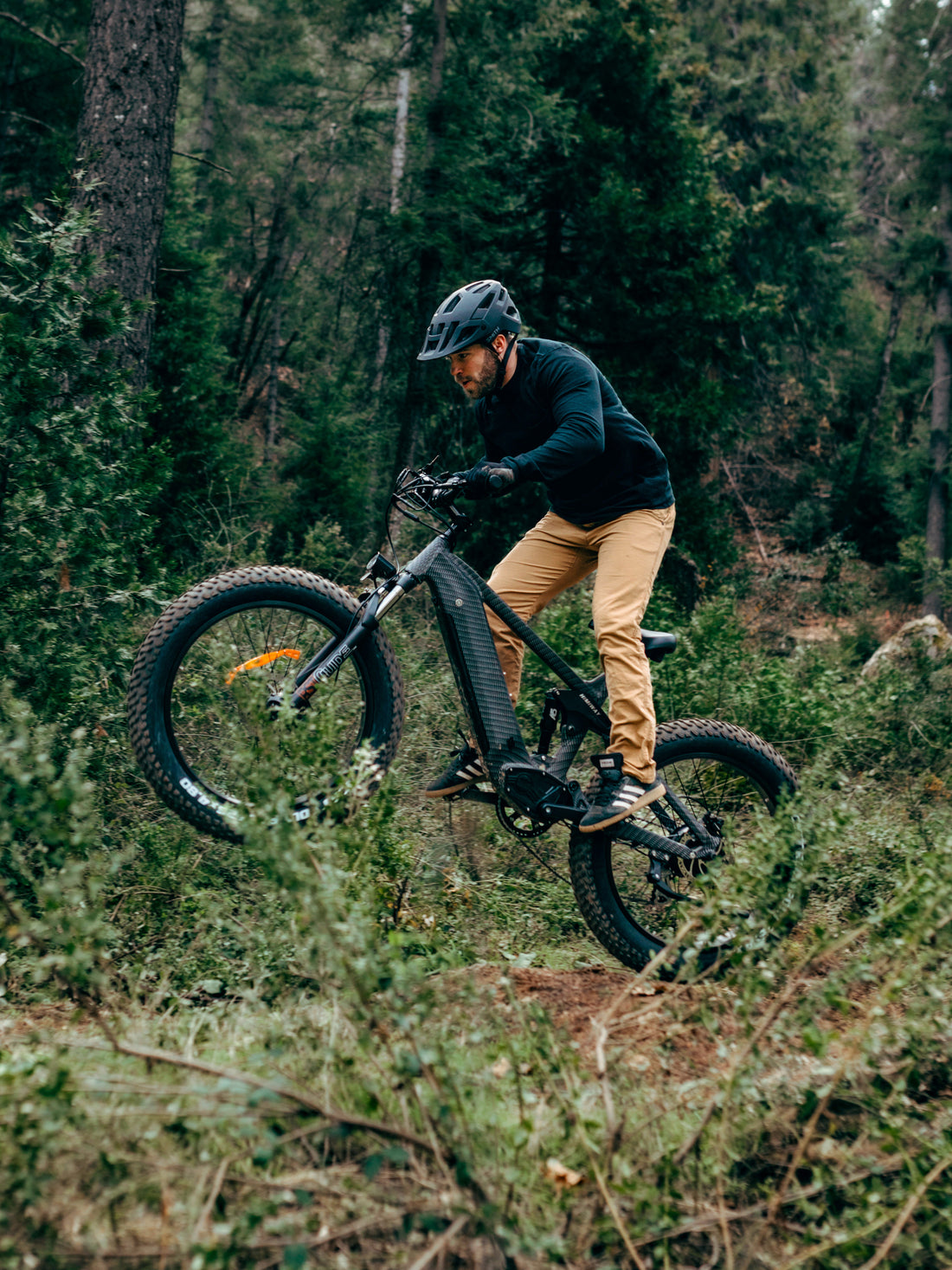
Is an Off-Road E-Bike Right for Me?

What is the best off-road electric bike for trails and dirt roads?

The best off-road electric bike depends on your terrain and riding style. For most adult riders tackling mixed trails and dirt roads, a full-suspension fat tire e-bike with 750W+ motor provides the right balance of capability and comfort.

Match the bike to your terrain:

  • Gravel roads and moderate trails: A 750W hub motor with 26x4.0" fat tires and front suspension handles these conditions well. The D5 Zebra delivers 60-80 miles of range with a 960Wh battery at the most accessible price point
  • Technical single-track and steep hills: A mid-drive motor multiplies torque through the gears. The D5 Pro provides 130Nm of mid-drive torque with 960Wh battery for extended trail sessions
  • Extreme off-road and mountain riding: The D7 Pro with 1000W Bafang M620 mid-drive (160Nm), four-bar linkage suspension, and 26x4.8" tires is built for the most demanding terrain
  • All-terrain versatility: The D5 2.0 with full suspension (100mm front + 130mm rear) and switchable torque/cadence sensor handles everything from paved paths to rocky trails

For more trail-ready options, browse our electric mountain bike collection or read the hardtail vs full suspension comparison.

What's it like to ride an off-road electric bike?

Riding an off-road e-bike feels like having a powerful tailwind that follows you everywhere — up hills, through sand, and over rough terrain that would normally force you to walk.

What to expect on your first ride:

  • The motor responds to you, not the other way around: With a torque sensor, push the pedals harder and the motor pushes back harder. It feels like having stronger legs, not like sitting on a motorcycle
  • Fat tires change everything: 4.0"–4.8" tires at 10-15 PSI float over surfaces that would stop a regular bike — loose gravel, soft sand, packed snow, muddy ruts
  • Suspension makes speed comfortable: At 15-20 mph on rough trails, every bump hits harder. Full suspension (100mm–220mm travel) absorbs rocks and roots so you focus on the trail, not your joints
  • Hills stop being obstacles: A 750W motor with 90Nm torque pulls a 250 lb rider up moderate grades without heavy breathing. For steep mountain grades (15-20%), a 1000W mid-drive with 160Nm makes climbing feel effortless
  • Range is generous: On pedal assist Level 2-3, expect 50-65 miles of real-world range on mixed terrain. That's a full day of trail riding without worrying about battery

Curious about how the motor types differ on trails? Our hub motor vs mid-drive guide explains the trade-offs. See all full suspension e-bikes for trail-ready options.

What is the best electric off-road bike for adults over 250 lbs?

Adults over 250 lbs need an off-road e-bike with at least 400 lb total weight capacity to account for rider weight plus gear, water, and cargo. Frame reinforcement and component durability matter more at higher loads.

What heavy riders should prioritize:

  • 400 lb payload capacity: Most Himiway off-road models support 400 lbs total. This means a 280 lb rider still has 120 lbs of headroom for gear, water bottles, and a loaded rack
  • Fat tires at lower PSI: Wider tires (4.0"–4.8") at 10-15 PSI distribute weight across more surface area, preventing the sinking and rim strikes that plague standard tires under heavy loads
  • Reinforced frames: 6061 aluminum alloy with double-thickness tubing handles the additional stress without frame flex. The D5 Zebra uses frames 2x thicker than conventional designs
  • Hydraulic brakes: At higher combined weight, stopping distances increase. Hydraulic disc brakes (180mm–203mm rotors) provide the consistent stopping power that mechanical brakes can't match

See our 400 lb capacity e-bike collection and e-bikes for heavy riders for models specifically designed for larger adults.

Off-Road E-Bikes for Hunting & Outdoor Adventures

What is the best off-road electric bike for hunting?

A hunting e-bike needs quiet operation, high weight capacity for gear, long range for remote areas, and ideally a camouflage-ready design. Two models stand out for different hunting scenarios.

For serious backcountry hunting:

  • D7 Pro: 1000W Bafang M620 mid-drive with 160Nm torque handles steep ridgelines and rough logging roads. 960Wh battery provides 60-80 miles — enough for a full day in remote territory. Four-bar linkage suspension with RockShox rear shock absorbs terrain that would break lesser bikes. 26x4.8" CST tires grip mud, loose rock, and wet forest floors
  • D5 2.0 Camo: Seamless nature camo wrap, step-through frame for mounting with heavy packs, quiet 750W hub motor that won't spook game, and 1,000 lb towing capability for hauling gear or game. Same proven D5 2.0 full suspension platform

Key specs for hunting use:

  • Range: Minimum 60 miles — you don't want to run out 30 miles from the truck
  • Weight capacity: 400 lb total — rider plus firearm, pack, water, and harvested game
  • Tires: 4.0"+ fat tires for silent rolling over leaves and loose dirt

Browse our hunting e-bike collection, deer hunting e-bikes, and hunting e-bikes under $2000.

Can off-road e-bikes handle camping trips and all-day adventures?

Yes. With 960Wh batteries delivering 60-80 miles on pedal assist, you can cover serious distance to remote camping spots and still have battery left for the return trip — or charge overnight from a vehicle or solar setup.

What makes an e-bike camping-capable:

  • Range planning: A 960Wh battery at PAS Level 2-3 gives 50-65 miles on mixed terrain. For a 20-mile ride to camp and back, that leaves 40%+ battery as safety margin
  • Cargo capacity: MIK-compatible rear racks carry panniers, dry bags, and camp kitchen gear. The D5 2.0's rack is compatible with 1,000+ accessories
  • Terrain flexibility: Switchable Class 1/2/3 lets you ride paved roads to the trailhead (Class 3, 28mph) then switch to trail-legal Class 1 (20mph) on the trail itself
  • Durability: 6061 aluminum frames, hydraulic brakes, and Shimano drivetrains are designed for sustained off-road use, not just weekend rides

For camping-specific setups, see our camping e-bike collection. Need maximum range? Check our long-range e-bike collection.

Performance, Power & Range

Hub motor vs mid-drive: which is better for off-road riding?

Both work off-road, but they excel in different conditions. Hub motors are quieter and lower-maintenance. Mid-drives are more powerful on steep climbs and technical terrain.

When to choose a hub motor (750W, 86-90Nm):

  • Moderate trails, gravel roads, fire roads, and mixed terrain
  • You value quiet operation (important for hunting and wildlife areas)
  • Lower maintenance priority — no chain-related motor wear
  • Models: D5 2.0 (90Nm), D5 Zebra (86Nm)

When to choose a mid-drive (500W-1000W, 130-160Nm):

  • Steep mountain grades (15-20%+) where gear multiplication matters
  • Technical single-track where instant torque response prevents stalling
  • Better weight distribution (motor at the crank, not the rear hub) improves handling on descents
  • Models: D5 Pro (130Nm), D7 Pro (160Nm)

For a deeper technical breakdown, read our hub motor vs mid-drive comparison guide. See all mid-drive e-bikes or 750W e-bikes.

How far can an off-road e-bike go on a single charge?

On pedal assist, expect 50-80 miles depending on battery size, terrain, and assist level. Off-road conditions typically reduce range 15-25% compared to flat road riding due to increased motor effort on hills and loose surfaces.

Real-world range by battery size:

  • 720Wh battery (D5 2.0, D3 Cruiser): 50-65 miles on mixed off-road terrain at PAS Level 2-3. The D5 2.0 achieves 65 miles on pedal assist vs 40 miles on throttle alone
  • 960Wh battery (D5 Zebra, D5 Pro, D7 Pro): 60-80 miles on mixed terrain. Enough for a full day of trail riding with significant elevation changes

How to maximize off-road range:

  • Use PAS Level 1-2 on flat sections, save Level 4-5 for steep climbs
  • Shift to lower gears before hills — the motor works more efficiently at higher cadence
  • Maintain tire pressure at 10-15 PSI for off-road (lower = more grip but slightly more rolling resistance)
  • Carry weight low and centered — heavily loaded rear racks increase motor effort on climbs

For maximum range priorities, explore our long-range e-bike collection. Learn more about battery optimization and maintenance.

Do I need full suspension for off-road riding, or is a hardtail enough?

It depends on your trail conditions and speed. At pedal-assist speeds (15-20 mph), bumps hit harder than they do on a regular bike, making suspension more valuable on an e-bike than on a traditional mountain bike.

When a hardtail (front suspension only) works:

  • Gravel roads, packed dirt, and maintained fire roads
  • Budget priority — models like the D5 Zebra deliver 60-80 miles range with front suspension at a lower price
  • Riders who prioritize range and simplicity over maximum comfort

When full suspension is worth it:

  • Rocky trails, root-covered single-track, and technical descents
  • Riders over 200 lbs — more weight means more impact force on bumps
  • All-day rides where fatigue accumulates — rear suspension reduces lower back strain
  • The D5 2.0 (100mm front + 130mm rear) handles most trail conditions. The D7 Pro (220mm front + RockShox rear) handles the most extreme terrain

For a complete breakdown, read our hardtail vs full suspension guide. Compare options in the full suspension collection and hardtail collection.

Trail Access, Legal & Practical Questions

Can I ride an off-road e-bike on public trails and bike paths?

Class 1 e-bikes (pedal assist only, max 20 mph) have the widest trail access and are accepted on most public paths and trails where traditional bicycles are permitted.

How the class system affects trail access:

  • Class 1 (PAS only, 20 mph): Accepted on most trails, multi-use paths, national park trails, and shared paths. The most access-friendly class
  • Class 2 (throttle + PAS, 20 mph): Allowed on most roads and many urban bike paths. Some natural trails restrict throttle-equipped bikes
  • Class 3 (PAS, 28 mph): Generally road-only. Restricted from most trails and shared paths due to higher speed

Practical approach: Himiway off-road e-bikes feature a switchable class system. Set your bike to Class 1 mode for trail riding to comply with regulations, then switch to Class 2 or 3 for road commuting. Many hunting areas and state forests now allow Class 1 e-bikes. Always check local rules before riding. Learn more about the three-class e-bike system. See our electric mountain bike collection for trail-ready options.

Are off-road electric bikes street legal for road riding?

Yes. All Himiway off-road e-bikes are street-legal as they comply with federal e-bike regulations (Class 1/2/3), include integrated lighting systems, and feature reflective elements.

What makes an off-road e-bike road-ready:

  • Lighting: All models include integrated LED headlights (48V high-brightness) and auto-illuminating brake lights
  • Speed compliance: Default max speed is 20 mph (Class 1/2), adjustable up to 28 mph (Class 3) for road use
  • Safety certification: UL 2849 whole-bike certification verifies electrical, fire, and mechanical safety standards
  • Reflective elements: Tire sidewall reflective strips for visibility in low light

Road performance trade-off: Fat tires (4.0"+) create more rolling resistance on pavement than standard tires, slightly reducing top speed and efficiency on roads. For riders who split time between trails and roads, the D5 2.0 with Maxxis tires offers good pavement performance while maintaining off-road capability. For a road-and-trail comparison, read our do-it-all e-bike guide.

How do I choose the right size off-road e-bike?

Off-road e-bike sizing depends on standover height, weight capacity, and how the adjustable components match your body. Getting this right matters more off-road than on pavement because you need to dismount quickly on technical terrain.

Key sizing factors:

  • Rider height range: Most Himiway off-road models fit 5'1"–6'5". The D5 2.0 features 0-60° adjustable stem and wide seat adjustment for fine-tuning
  • Standover height: The D5 2.0 ST step-through has a 19.3" standover (easy mounting with heavy gear). The D5 2.0 high-step has a 27.6" standover for sportier handling
  • Weight vs frame type: Step-through models make mounting easier when carrying a pack, wearing hunting boots, or dealing with knee issues. Step-over frames offer more frame rigidity on aggressive terrain

For shorter riders (under 5'4"): The D5 2.0 20" with 17" standover height and 20" wheels provides a lower center of gravity and easier handling while keeping full suspension and 440 lb payload capacity.

Browse e-bikes for short riders or e-bikes for tall riders. Compare frame styles in our step-over vs step-through guide.

What maintenance does an off-road e-bike need?

Off-road riding accelerates wear on tires, brake pads, chains, and suspension compared to road use. A simple maintenance schedule keeps everything running safely.

After every off-road ride:

  • Wipe down the frame and clean mud from the drivetrain — grit accelerates chain and gear wear
  • Check tire pressure (10-15 PSI for off-road, higher for pavement)
  • Inspect brake pads for wear — off-road descents use brakes far more than flat road riding

Monthly (or every 200 miles):

  • Lubricate the chain — off-road conditions strip lubricant faster
  • Check spoke tension — rough terrain can loosen spokes
  • Inspect suspension for oil leaks or reduced travel
  • Test all bolts and quick-release mechanisms — vibration can loosen hardware

Battery care: Store between 40-80% charge when not riding. Avoid leaving fully charged or fully drained for extended periods. Samsung/LG cells maintain 80%+ capacity after 1,000 charge cycles with proper care.

For detailed guides, see our D5 2.0 maintenance guide and battery optimization guide. Read our safety checklist before hitting the trails.

Why HIMIWAY ?

Ride Further Together

491 K+

Himi Riders
Recognition from knights around the world

15 K+

5-Star Reviews
The knights give an honest opinion

1200 +

Professional Review
What the professional media really thinks of us

Local Shop

Learn More

2-Year Warranty

Learn More

15-Day Trial

Learn More

Free Shipping

Learn More

Bikes for Every Ride

Explore our diverse lineup designed to fit every rider and terrain

Mountain eBike

Kids eBike

City eBike

Cargo eBike

Folding eBike

Find a Local Himiway Shop Near You

Looking for a hands-on experience?
Find a Himiway electric bike shop near you and schedule a test ride today.