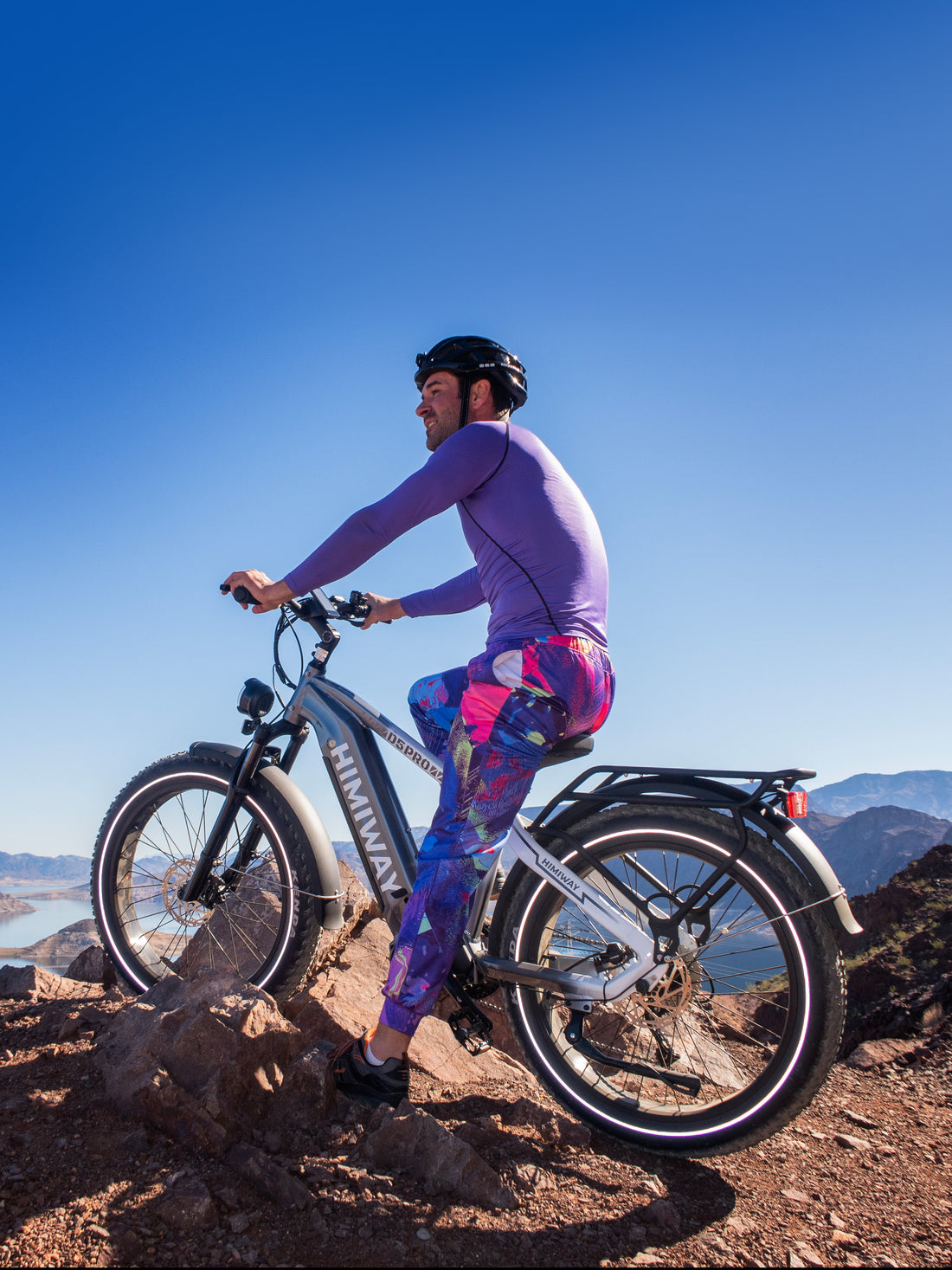
electric mobility bike

electric mobility bike

1000+Shop

2-Year Warranty

15-Day Trial

Free Shipping

Best Electric Mobility Bikes Guide

Find the right electric mobility bike for your needs — whether you're returning to cycling after surgery, managing arthritis, or seeking reliable daily transportation that doesn't demand a healthy body.

What Makes an Electric Bike a True Mobility Aid

🦿 Easy On, Easy Off

  • Step-through frames with 17"–22.4" standover height — swing one leg over without pain or balance risk
  • Throttle mode gets you moving without pedaling during flare-ups, recovery days, or fatigue
  • Walk mode (1.9–3.7 mph) lets the motor push the bike for you through crowded spaces or difficult terrain
  • D5 2.0 20" fits riders from 4'11" with a 17" standover — the lowest entry point in the lineup

⚡ Power That Adapts to Your Body

  • 5-level pedal assist: Level 1 for gentle exercise, Level 5 when your body needs maximum support
  • Torque sensors match motor output to your effort — no jarring on/off power surges that stress joints
  • 750W motors with 70–90Nm torque handle hills that would force mobility-limited riders to walk
  • Switchable cadence/torque sensing lets you choose gentle cadence mode or responsive torque assist

🔋 Go Farther Than Walking Allows

  • 65–70 miles on a single charge — riders who can't walk through a grocery store report riding 7–10 miles pain-free
  • Throttle as your safety net: if energy runs out mid-ride, engage full motor support and coast home
  • UL2271 certified Samsung/LG cells maintain 80%+ capacity after 1,000 charges
  • UL2849 whole-bike certification ensures electrical and mechanical safety for daily use

Our Top 3 Picks

🏆 Best Overall Mobility Bike

Himiway D5 2.0 ST

Full suspension (100mm front RST fork + 130mm rear multi-link) with a 19.3" step-through standover. Switchable torque/cadence sensor and 5-level PAS let you dial the exact support your body needs on any given day. Memory foam saddle and 0–60° adjustable stem ensure a pain-free riding position.

750W 90Nm | 720Wh | 65mi | 400lb capacity

🌟 Best for Shorter & Petite Riders

Himiway D5 2.0 20"

The lowest standover in the entire lineup at just 17" — fits riders from 4'11". Compact 20" wheels lower the center of gravity for better stability at slow speeds. At 80 lbs, it's 12 lbs lighter than the 26" D5 2.0, yet carries up to 440 lbs. Walk mode and full suspension included.

750W 90Nm | 720Wh | 70mi | 440lb capacity

💜 Best for Comfortable Daily Commuting

Himiway A7

Full suspension (120mm SR-SUNTOUR front + 90mm four-link rear) with a 220mm wide memory foam saddle — the widest in the Himiway lineup. 27.5" wheels roll smoothly over pavement, reducing vibration through hands and wrists. Rated 5.0/5 stars across 39 verified reviews.

750W 70Nm | 720Wh | 65mi | 400lb capacity

Electric Mobility Bike FAQ

Real questions from riders managing health limitations — answered with specific scenarios, so you can decide with confidence.

Can I Actually Ride One?

Can I ride an electric bike with bad knees or arthritis?

Yes — pedal-assist cycling is one of the few exercises physicians recommend for knee arthritis and joint pain, because the motor supplements leg power so joints never bear the full load of propulsion.

Why e-bikes work for joint pain:

  • Low-impact movement: Cycling moves knee joints through a full, smooth range of motion without the impact shock of walking or running. The motor carries the load; your joints get the motion benefit without the strain
  • Adjustable effort: At PAS Level 4–5, your legs contribute minimal force — less than walking on flat ground. Use Level 1–2 on good days for exercise; Level 4–5 on bad days for transportation
  • Hill protection: The most knee-stressful part of cycling is climbing hills. At 90Nm of torque, the motor handles climbs automatically — your knees never feel a steep grade
  • Step-through frames: The D5 2.0 ST (19.3" standover) and D5 2.0 20" (17" standover) eliminate the painful leg-swing required by traditional bike frames

Riders managing knee replacement recovery and chronic arthritis report cycling 5–10 miles on days they can't comfortably walk two blocks. For more resources, see our arthritis e-bike collection and complete arthritis buyer's guide.

Is an electric bike safe if I have balance problems or a mobility disability?

Electric bikes can actually be safer than traditional bikes for balance-challenged riders — lower standover heights, throttle for smooth starts, and wider fat tires all reduce the instability moments that cause falls.

What makes mobility e-bikes safer for balance issues:

  • Smooth, controlled starts: Throttle mode eliminates the wobble-prone pedal-push launch of a traditional bike. Press the throttle gently, build speed smoothly, and find your balance before committing to pedaling
  • Fat tire stability: 26x4.0" tires on the D5 2.0 ST provide a wider contact patch than standard road tires, improving stability at low speeds — the moment when balance is most critical
  • Low standover for quick dismounts: The 17" standover on the D5 2.0 20" means both feet reach the ground flat, giving full grounding confidence at stops
  • Walk mode safety: In crowded or uncertain situations, engage walk mode (1.9–3.7 mph) and let the motor guide the bike rather than trying to balance and push simultaneously

Riders who cannot walk 10 meters unsupported report riding 15+ minutes on e-bikes by using throttle for starts and keeping PAS at Level 3–4 for sustained momentum. See our seniors e-bike collection and balance problems guide for more detail.

Can an electric bike replace a car for someone with limited mobility?

For local trips under 30 miles — groceries, medical appointments, commuting to work — an electric mobility bike provides practical, independent transportation without requiring a driver's license, parking, or fuel costs.

What makes e-bikes a real car alternative for limited mobility:

  • Range that covers daily needs: 65–70 miles on a single charge handles most errands. Riders with hip disorders and mobility limitations report e-bikes as their primary transport when driving is off the table
  • Cargo for errands: MIK rear rack systems accept panniers and baskets for groceries. The D5 2.0 20" rack handles 120 lbs — enough for a full grocery run or medical equipment
  • Bad-day reliability: On days when pedaling feels impossible, throttle-only mode requires zero physical effort. The motor does everything; you just steer and brake
  • Weather protection: IPX5/IPX6 water resistance means light rain doesn't cancel your trip

For maximum range priority, explore our long-range e-bike collection. Need a cargo setup for hauling gear? See e-bikes with basket options.

Which One Is Right for My Situation?

What is the best electric bike for a disabled or recovering rider?

The best electric bike for a disabled or recovering rider depends on your specific limitation — frame entry, weight capacity, suspension comfort, and control type all matter differently depending on your condition.

Match your condition to the right model:

  • Hip replacement / knee surgery recovery: D5 2.0 ST — 19.3" step-through standover eliminates the hip-flexor strain of swinging a leg over a high top tube. Full suspension absorbs road vibration that would stress healing joints
  • Short stature or low mobility (4'11"–5'4"): D5 2.0 20" — 17" standover and 20" compact wheels place you closer to the ground with better stability
  • Chronic fatigue / invisible disability: Any model with throttle mode — engage Level 5 PAS or full throttle on bad days, use Level 1–2 on good ones. The A7's wide saddle reduces fatigue from prolonged sitting
  • Upper body weakness (arms, hands): A7 — SHIMANO hydraulic brakes require minimal hand force. 0–60° adjustable stem reduces wrist and shoulder strain from improper reach angle
  • Obesity / high body weight: D5 2.0 20" at 440 lbs capacity, or D5 2.0 ST at 400 lbs

Browse our full step-through collection for mobility riders and read the complete seniors guide for additional context.

How do I choose between step-through frame sizes for mobility needs?

Standover height is the most critical measurement for mobility riders — it determines whether you can mount and dismount safely without painful hip flexion, loss of balance, or needing assistance.

Standover height comparison for mobility riders:

  • 17" standover (D5 2.0 20"): Both feet flat on the ground. Ideal for riders with severe hip restrictions, balance disorders, or who need full grounding confidence at stops. Fits 4'11"–6'3"
  • 19.3" standover (D5 2.0 ST): One foot flat, one tiptoe — comfortable for most adults 5'1"–6'5". Step-through frame eliminates leg swing entirely
  • 22.4" standover (D5 Zebra ST / D5 Pro ST): Tiptoe contact. Suitable for riders with good balance who primarily need the step-through for convenience rather than mobility necessity

Quick self-test: Stand next to a step and try lifting one leg to knee height while balancing. If that's painful or difficult, choose 17" over 19.3". If bending at the hip past 90° is restricted, the lower standover is essential.

Compare all step-through options in our step-through collection. For smaller frames, see e-bikes for short riders. Read our step-over vs step-through guide for a full breakdown.

Do I need full suspension for a mobility e-bike, or is front-only sufficient?

For mobility riders — especially those with back pain, spinal conditions, or joint sensitivity — full suspension is worth the investment because it eliminates the jarring impacts that accumulate into pain on longer rides.

When front suspension only is acceptable:

  • Smooth pavement, bike paths, and gentle gravel only
  • Riders whose primary concern is mounting/dismounting, not vibration management
  • Budget priority — the D5 Zebra ST offers 960Wh range with front suspension at a lower cost

When full suspension is essential:

  • Chronic back pain, herniated discs, or post-spinal surgery — every bump transmits to the spine on a hardtail
  • Riding on streets with potholes, expansion joints, or rough pavement
  • Rides longer than 5 miles where vibration accumulates — the D5 2.0 ST (100mm front + 130mm rear) and A7 (120mm front + 90mm rear) handle rough surfaces without transmitting impact to rider

Riders with S1 vertebrae issues and tailbone conditions report zero pain on full suspension models on routes that caused significant discomfort on rigid frames. For more technical detail, read our hardtail vs full suspension comparison. See all full suspension e-bikes.

Will It Actually Help Me?

Does riding a pedal-assist e-bike count as real exercise?

Yes — pedal-assist e-biking provides genuine cardiovascular and muscular exercise, particularly at PAS Levels 1–3. Research consistently shows e-bike riders cycle more frequently, for longer distances, and with greater consistency than riders on traditional bikes.

How PAS levels map to exercise intensity:

  • PAS Level 1: Light assist — similar effort to cycling on a gentle incline. Good for cardiovascular training without joint overload
  • PAS Level 2–3: Moderate assist — comfortable sustained effort for 30–60 minute rides. Heart rate elevation without exhaustion
  • PAS Level 4–5: Heavy assist — transportation mode. Still requires leg movement but minimal cardiovascular demand

Real impact for mobility-limited riders:

  • Riders crediting e-bikes as a significant factor in weight loss — covering 10+ miles where they previously couldn't sustain 1 mile on a regular bike
  • Consistent cyclists with back pain report that 5 miles daily on pedal assist keeps pain at a manageable level versus days without riding
  • The key advantage: e-bikes remove the "hill barrier" that causes most mobility-limited riders to stop — the motor handles climbs so riders continue rather than turn back

For exercise-focused riding, the torque sensor models provide the most natural, proportional exercise experience. See our pedal assist collection for options optimized for active riding.


How far can I realistically ride with limited fitness or stamina?

On PAS Level 3–4, most mobility-limited riders achieve 5–15 miles on their first ride — far beyond what they could manage on a traditional bike or on foot. With practice, 20–30 mile rides become achievable within a few months.

Realistic range expectations by fitness level:

  • Very limited fitness (can walk less than 0.5 miles): Start with 3–5 miles at PAS Level 4–5. The motor does most of the work; your legs contribute motion without exhaustion. Use throttle on hills
  • Moderate limitation (can walk 1–2 miles): 8–15 miles at PAS Level 2–3. Mix throttle for hills and Level 2 on flats for a genuine workout that builds endurance without damage
  • Building fitness: Progress from PAS 4–5 toward PAS 1–2 over weeks. The motor's range (65–70 miles) gives you a virtually unlimited safety net — you'll never be stranded by your own fatigue

Battery as your insurance policy: Unlike a traditional bike where bonking means a struggle home, an e-bike at PAS Level 5 or throttle-only mode can return you from any distance within the bike's range. Push your limits knowing the motor has you covered.

For detailed battery management, read our battery optimization guide. See long-range e-bike options for extended adventure coverage.

Can my partner ride with me if we have very different physical abilities?

Yes — the 5-level assist system means two riders on different bikes can comfortably ride together regardless of fitness gap. One partner at PAS Level 1 gets a workout; the other at PAS Level 5 gets full support. You set the same pace naturally.

Common mobility couple combinations:

  • One healthy, one mobility-limited: Healthy partner at Level 1–2 (exercise mode), mobility-limited partner at Level 4–5 (support mode) — both travel at the same comfortable 10–15 mph pace
  • Both with different conditions: Partner with arthritis uses torque-sensor mode for natural assist; partner with back pain uses cushioned suspension model. Different bikes, same ride
  • Size-matched pairs: The D5 2.0 26" (fits 5'1"–6'5") paired with the D5 2.0 20" (fits 4'11"–6'3") allows couples with height differences to share the same ride design and components

Explore our family e-bike collection for paired riding setups. See the full D5 series to compare model options for couples.

Practical Questions Before You Buy

How heavy are these bikes, and can I manage one with limited strength?

Electric mobility bikes weigh 80–92 lbs with battery — heavier than traditional bikes but manageable with the right setup. Key features eliminate the need to lift or manhandle the bike in most scenarios.

Weight management strategies for limited strength:

  • Walk mode replaces pushing: In parking lots, on ramps, or anywhere you'd normally push a heavy bike, engage walk mode (1.9–3.7 mph). The motor pushes the bike; you just steer with minimal effort
  • Removable battery reduces transport weight: The battery alone weighs ~8 lbs. Remove it before loading the bike into a car or storage area, then handle the frame at 72–84 lbs
  • Lightest option: The D5 2.0 20" at 80 lbs is 12 lbs lighter than the standard D5 2.0, making it the most manageable full-suspension option. The A3 at 68.3 lbs is the lightest in the entire lineup for riders prioritizing minimal weight
  • Kickstand stability: All models include adjustable kickstands that prevent tipping when parked, eliminating the need to catch or hold the bike while loading accessories

If weight is a primary concern, see our e-bikes with removable battery and most comfortable e-bikes collections.

What safety features should a mobility e-bike have?

Mobility riders need safety features that reduce the consequences of fatigue-related mistakes — reliable braking, visibility, automatic lighting, and smooth power delivery are the critical checklist.

Non-negotiable safety features for mobility riders:

  • Hydraulic disc brakes: SHIMANO MT200 hydraulic brakes (fitted on A7 and A7 Pro) require significantly less hand pressure than mechanical brakes — critical for riders with hand weakness or arthritis. Tektro hydraulic brakes on D5 models provide equivalent stopping power
  • Integrated auto-lighting: Front LED (48V, 500LM) and brake-activated rear light illuminate automatically. Visibility is crucial for riders who may be slower at intersections
  • UL 2849 whole-bike certification: Verifies electrical, fire, and mechanical safety standards. All Himiway mobility models carry this certification
  • Throttle for intersection security: When a light turns green and traffic starts moving, throttle provides instant acceleration without the coordination required to push-pedal-launch a traditional bike
  • Reflective tire sidewalls: Innova tires on A7 models include reflective strips for low-light visibility

Before your first ride, follow our e-bike safety checklist. All displayed models are UL certified for verified safety standards.

Should I use throttle-only mode or pedal assist for mobility riding?

Use both — strategically. Throttle for starts, intersections, and bad days; pedal assist (PAS Level 3–5) for sustained riding. This combination maximizes range, safety, and whatever exercise benefit your body allows on a given day.

When throttle is the right choice:

  • Starting from a stop — the wobbly moment where balance and coordination stress peaks
  • Intersections where you need to clear traffic quickly
  • Flare-up days, post-procedure days, or high-fatigue days when pedaling isn't possible
  • Steep hills where even Level 5 PAS feels demanding

When pedal assist is better:

  • Sustained riding — PAS preserves up to 60% more battery range than throttle-only (the D5 2.0 delivers 65 miles on PAS vs 40 miles throttle-only)
  • Exercise benefit — even gentle Level 1–2 pedaling provides cardiovascular and joint mobility benefits
  • Natural feel — torque sensor PAS responds to your effort rather than a fixed power output, making it feel more like cycling than motor-powered transport

For a complete comparison, read our pedal assist vs throttle guide. See e-bikes with both throttle and pedal assist for all available options.

What if my weight exceeds 300 lbs — are these bikes strong enough?

Several Himiway mobility models support 400–440 lbs total weight capacity, with reinforced frames, fat tires designed for high-load distribution, and hydraulic braking systems scaled for heavier riders.

Weight capacity by model:

  • 440 lb capacity: D5 2.0 20" — highest capacity in the D5 family. φ33.9mm reinforced seatpost prevents bending under heavy riders. 203mm front brake rotor provides stronger stopping power
  • 400 lb capacity: D5 2.0 ST, A7, D5 Zebra ST — reinforced 6061 aluminum frames with 2x standard wall thickness
  • 300 lb capacity: A3 — lighter unibody construction optimized for urban commuting; not recommended for riders over 280 lbs

Why fat tires matter for heavier riders: 4.0" tires at 10–15 PSI distribute rider weight across a larger contact patch, reducing rim stress and preventing the pinch flats that standard tires suffer under high loads. The wide stance also improves stability at low speeds.

See our dedicated 400 lb capacity e-bike collection and heavy rider collection. For riders 280–350 lbs, see e-bikes for 300 lb riders.

Why HIMIWAY ?

Ride Further Together

491 K+

Himi Riders
Recognition from knights around the world

15 K+

5-Star Reviews
The knights give an honest opinion

1200 +

Professional Review
What the professional media really thinks of us

Local Shop

Learn More

2-Year Warranty

Learn More

15-Day Trial

Learn More

Free Shipping

Learn More

Bikes for Every Ride

Explore our diverse lineup designed to fit every rider and terrain

Mountain eBike

Kids eBike

City eBike

Cargo eBike

Folding eBike

Find a Local Himiway Shop Near You

Looking for a hands-on experience?
Find a Himiway electric bike shop near you and schedule a test ride today.