



Men's Electric Bikes


Himiway D5 2.0 Camo eBike Blend In, Ride Out: The Top Choice for Hunting
-
Full Suspension
Travel F:100mm R:130mm
-
Torque / Cadence
2 Riding Experiences
-
750W 90Nm
Geared Hub Motor
-
Smart Auto
5 Assist System


Himiway D5 2.0 eBike Endless Comfort: Turning Rough Roads into Silk.
-
Full Suspension
Travel F:100mm R:130mm
-
Torque / Cadence
2 Riding Experiences
-
750W 90Nm
Geared Hub Motor
-
Smart Auto
5 Assist System


Himiway D5 2.0 ST eBike Endless Comfort: Turning Rough Roads into Silk.
-
Full Suspension
Travel F:100mm R:130mm
-
Torque / Cadence
2 Riding Experiences
-
750W 90Nm
Geared Hub Motor
-
Smart Auto
5 Assist System


Himiway D5 2.0 20" eBike Easy to Maneuver. Built for Power.
-
Full Suspension
Travel F:90mm R:100mm
-
Torque / Cadence
2 Riding Experiences
-
750W 90Nm
Geared Hub Motor
-
440 lb.
Payload Capacity

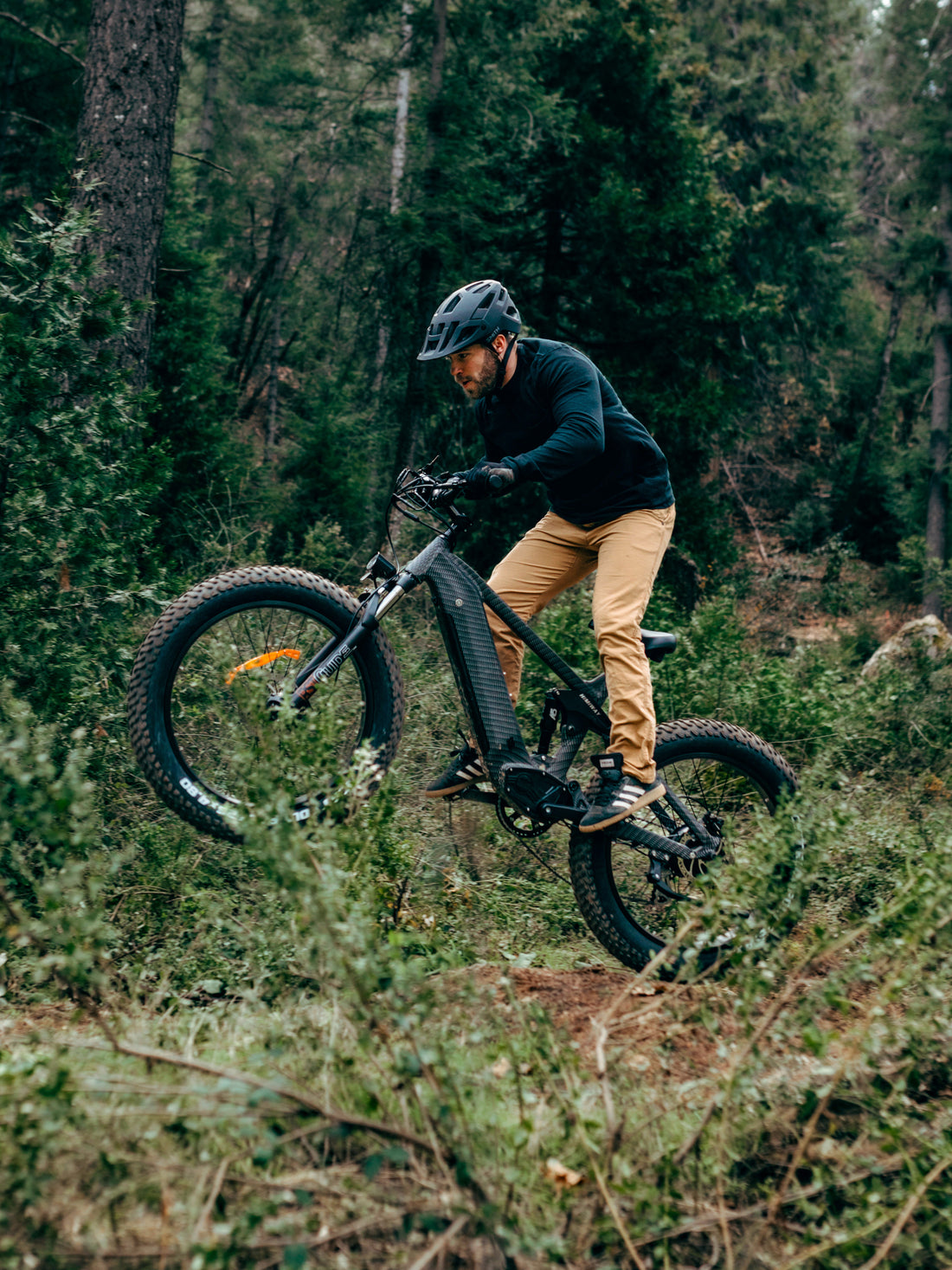
D7 / Full Suspension Electric Hunting Bike
-
80 Miles
Max Range
-
26x4.5
Super Fat Tire
-
Torque
Sensor
-
Hydraulic
Brakes


Himiway D7 Pro Mountain eBike Unstoppable mountain performance
-
1000 W
Mid-drive Motor
-
28 Mph
Top Speed
-
960 Wh
Samsung/LG Battery
-
80 Miles
Max Range


D5(Zebra) / All-terrain Electric Fat Bike
-
Torque
Sensor
-
960 Wh
Samsung/LG Battery
-
80 Miles
Max Range
-
750W
Motor


D5 ST(Zebra ST) / All-terrain Electric Fat Bike
-
Torque
Sensor
-
80 Miles
Max Range
-
400 lb.
Max Playload
-
Hydraulic
Brakes
- Featured
- Most relevant
- Best selling
- Alphabetically, A-Z
- Alphabetically, Z-A
- Price, low to high
- Price, high to low
- Date, old to new
- Date, new to old
The best men's electric bikes match your riding style—whether you're commuting through city traffic, exploring trails on weekends, or getting back into cycling after years away. Look for motor power that handles your terrain, frame geometry that fits your height, and weight capacity that supports your build. Top options include the A7 for city commuting, D5 2.0 for all-terrain versatility, and D7 Pro for serious off-road performance.
Men's Electric Bikes Buying Guide
Our team has logged thousands of miles testing electric bikes across city streets, mountain trails, and everything in between. This guide distills what we've learned into practical advice for finding your ideal ride.
What to Look for in a Men's Electric Bike
🚴 Frame & Fit
- Height range typically 5'4" to 6'5" with adjustable components
- Adjustable stem (0-60°) lets you find your ideal riding position
- High-step frames for athletic riding, step-through for easy mounting
- Weight capacity from 300-440 lbs depending on model
- Seat post adjustment of 9"+ for proper leg extension
⚡ Motor & Power
- 500-750W hub motors for commuting and casual riding
- 750-1000W mid-drive motors for hills and off-road
- Torque sensors provide natural pedal feel under load
- Class 2 (20 mph) or Class 3 (28 mph) speed options
- Throttle mode for pedal-free riding when needed
🛞 Wheels & Terrain
- Standard tires (2.0-2.5") for pavement efficiency
- Fat tires (4.0-4.8") for mixed terrain and stability
- Front suspension for city comfort, full suspension for trails
- Hydraulic disc brakes for reliable all-weather stopping
- Puncture-resistant options for worry-free commuting
Top Men's Electric Bikes by Riding Style
🏙️ Best for City Commuting
Himiway A7 Urban Commuter
Lightweight design with full suspension for urban comfort. Class 3 capable for keeping pace with traffic. Shimano hydraulic brakes and integrated lighting for daily reliability.
500W Motor | 48V 14Ah Battery | 55+ mi Range | 350 lb Capacity
🏔️ Best for Mixed Terrain
Himiway D5 2.0 eBike
Full suspension fat tire bike that handles pavement and trails equally well. Switchable torque/cadence sensors adapt to different riding styles. MIK rack system for cargo versatility.
750W Motor | 720Wh Battery | 60-80 mi Range | 400 lb Capacity
⛰️ Best for Off-Road
Himiway D7 Pro Mountain eBike
1000W mid-drive with 160Nm torque conquers any hill. Four-bar linkage suspension with RockShox rear shock. 4-piston hydraulic brakes handle aggressive descents.
1000W Mid-Drive | 960Wh Battery | 60-80 mi Range | 400 lb Capacity
Men's Electric Bikes: Common Questions
Choosing Your First E-Bike
How do I choose the right men's electric bike for my needs?
Start by identifying your primary use case—this determines what features matter most:
- Daily commuting: Prioritize range (1.5x your round-trip distance), Class 3 speed for traffic, integrated lights, and rack compatibility for carrying work gear
- Weekend trail riding: Look for fat tires (4.0"+), suspension (front or full), and higher torque motors for varied terrain
- Fitness and exercise: Choose bikes with adjustable assist levels so you can control your workout intensity
- Mixed use: All-terrain fat tire bikes cover the widest range of scenarios
Then verify the fit:
- Check height range matches your body (most fit 5'4" to 6'5")
- Confirm weight capacity exceeds your body weight by at least 50 lbs for cargo margin
- Consider step-through frames if you'll be stopping frequently or carrying loads
For most men buying their first ebike, an all-terrain model like the D5 Zebra offers the best versatility—capable on roads and trails without overcommitting to one use case.
What's the difference between hub motors and mid-drive motors?
The motor type affects how your bike rides and what terrain it handles best:
-
Hub motors (in rear wheel):
- Simpler design with fewer parts to maintain
- Quieter operation—good for neighborhoods and shared paths
- Direct power delivery feels immediate on throttle
- Best for: flat to moderate terrain, city commuting, casual riding
- Limitation: can strain on long, steep climbs
-
Mid-drive motors (at pedals):
- Uses your bike's gears for better hill climbing efficiency
- Better weight distribution (motor at center instead of rear)
- More natural pedaling feel with torque sensors
- Best for: hilly areas, off-road, mountain trails
- Consideration: slightly more drivetrain wear
For flat urban commutes, hub motors work great and cost less. For hilly terrain or serious trail riding, mid-drive motors provide a significant performance advantage.
Learn more in our complete motor comparison guide.
I haven't ridden a bike in years—is an ebike a good way to get back into cycling?
Absolutely. Many riders return to cycling through ebikes after 10, 20, even 30 years away. The motor assistance removes the barriers that keep people from starting:
- No fitness prerequisite: Start riding immediately regardless of current conditioning
- Gradual progression: Use higher assist when needed, reduce it as you build strength
- Confidence on hills: Inclines that would have stopped you now become manageable
- Extended range: Cover distances you couldn't on a traditional bike
- Joint-friendly: Motor assistance reduces stress on knees and hips compared to purely human-powered cycling
For returning riders, comfort features matter: look for full suspension to absorb road imperfections, a wide saddle with memory foam, and adjustable handlebars so you're not hunched over. The D5 2.0 combines these features with straightforward controls.
Commuting & Daily Use
What's the best electric bike for commuting to work?
The ideal commuter ebike balances speed, range, and practical features for daily reliability:
- Range planning: Choose a battery with 1.5-2x your round-trip commute distance to account for cold weather, hills, and not always charging to 100%
- Speed capability: Class 3 (28 mph assist) keeps pace with urban traffic and reduces commute time
- Cargo capacity: Integrated racks or MIK-compatible systems let you carry laptops, lunch, and work gear
- Weather handling: Fenders keep you dry, fat tires handle wet roads and debris more confidently
- Visibility: Integrated lights (headlight + brake light) are essential for early morning or evening commutes
For pure urban commuting on good roads, the A7 offers a lighter weight option. For commutes with mixed surfaces or rougher roads, the D5 2.0 handles everything from potholes to gravel shoulders.
Can I ride an electric bike in rain and winter?
Yes—quality ebikes are designed for year-round use with proper precautions:
- Rain riding: Look for IP-rated electrical components (most quality ebikes handle rain without issue). Hydraulic brakes maintain stopping power when wet. Fenders keep road spray off you.
- Winter riding: Fat tires (4.0"+) provide traction in snow and ice. Cold weather reduces battery capacity 10-20%, so plan for shorter range. Store battery indoors when not riding.
- Road condition adaptability: Fat tires absorb potholes, handle storm drain covers, and ride over debris that would stop thinner tires
Real-world examples: Riders in Maine and Minnesota use fat tire ebikes through 5+ months of winter—the wide tires handle snow and ice that would be dangerous on standard bikes. In Michigan and states with notoriously poor road maintenance, fat tires absorb potholes and pavement breaks that would jar you off a traditional bike.
Post-ride maintenance for wet conditions: wipe down the frame, check brake pads periodically, and keep the chain lubricated.
How do I carry things on my ebike—laptop, groceries, work gear?
Modern ebikes offer multiple cargo solutions:
- Rear racks: Most models include integrated rear racks with 50-120 lb capacity. The MIK (Mounting Is Key) system offers 1,000+ compatible accessories.
- Panniers: Side bags attach to rear rack for balanced weight distribution—ideal for laptops and work documents
- Front baskets: Good for quick-access items but keep weight under 15 lbs to avoid affecting steering
- Frame bags: Fit in the triangle for tools, snacks, or small items
- Backpacks: Work but shift weight to your body—racks distribute weight to the bike itself
For regular grocery runs, consider a cargo-specific model like the C3 Cargo with 440 lb total capacity.
Fitness & Exercise
Can I get a real workout on an electric bike?
Yes—the workout intensity depends on how you use the assist levels:
- Low assist (Level 1-2): You do 70-90% of the work—genuine cardiovascular exercise
- Medium assist (Level 3): Moderate effort, good for building endurance over longer distances
- High assist (Level 4-5): Recovery rides or when you're tired
- Assist off: Full manual cycling (though heavier than a traditional bike)
The key advantage: ebikes enable consistent riding habits. Riders often exercise more frequently because the motor removes the mental barrier of "what if I get too tired?" You can always dial up assistance if needed.
Many riders report improved cardiovascular fitness, better leg strength, and enhanced mental health from regular ebike use—benefits that come from riding more often, not from the motor itself carrying all the load.
Is an ebike good for weight loss?
Ebikes can support weight loss goals effectively, often better than traditional bikes for one reason: consistency. Studies show ebike riders tend to ride more frequently and cover longer distances than traditional cyclists.
- Lower barrier to start: No need to be "in shape" before riding
- Scalable intensity: Start with high assist, reduce it as fitness improves
- Joint-friendly: Motor assistance reduces stress on knees and hips—critical for heavier riders
- Sustainable habit: Enjoyable activity you'll actually repeat
For weight loss specifically, choose a bike with multiple assist levels so you can progressively challenge yourself. Torque sensors also help by providing power proportional to your pedaling effort—you work harder, you get more assist, but you're always contributing.
Explore our fitness-focused electric bike collection for models optimized for exercise.
Size, Fit & Physical Considerations
What electric bike can handle a big guy—250, 300, or 350 lbs?
For heavier riders, look beyond basic weight ratings to the engineering details:
- Weight capacity buffer: Choose a bike rated 50+ lbs above your body weight to allow for cargo and safety margin
- Reinforced frames: Quality 6061 aluminum with thicker tubing at stress points—where cheaper frames crack
- Heavy-duty wheels: 32-36 spoke count prevents wheel flex and spoke breakage under load
- Hydraulic brakes: Mechanical brakes fade under heavier loads—hydraulic systems maintain consistent stopping power
- Higher torque motors: 90Nm+ prevents motor strain on hills with heavier riders
- Fat tires: Distribute weight over larger contact patch, reducing stress on components
Real-world validation: Riders at 6'2" and 340 lbs, 6'4" and 310 lbs, and 6'1" and 295 lbs consistently report excellent performance on canyon trails, mountain terrain, and daily riding covering 100+ miles with no issues. The key is choosing bikes actually engineered for the load, not just rated for it on paper.
The D7 Pro with its 160Nm torque and reinforced frame is specifically built for this use case. See all options in our electric bikes for heavy riders collection.
Are there electric bikes for tall riders over 6'2"?
Yes. The key issues tall riders encounter with standard bikes—and what to look for:
- Cramped cockpit: Knees hitting handlebars, hunched riding position → Look for adjustable stems (0-60°) and extended reach geometry
- Incomplete leg extension: Seatpost not tall enough → Look for 9.8"+ seat post adjustment range
- Awkward proportions: Frame looks too small → 26" wheels with fat tires often balance better visually for larger riders
Most Himiway models fit riders up to 6'5" with proper adjustment. For riders at the tall end of this range, the high-step frame versions typically provide better geometry than step-through versions.
Before purchasing, verify the specific model's height range and consider seat post and stem upgrades if you're at the upper limit.
Step-through or high-step frame—which is better for men?
Neither is inherently "better"—choose based on how you'll use the bike:
-
High-step frames work well if you:
- Prefer traditional bike aesthetics
- Want slightly stiffer frame feel
- Don't have hip/knee flexibility issues
- Prioritize aggressive riding position for trails
-
Step-through frames work well if you:
- Stop frequently in traffic or on errands
- Carry passengers or cargo on rear
- Have any hip/knee stiffness
- Ride on uneven surfaces where quick dismounting helps
- Prefer easier mounting with boots or work clothes
Modern step-through frames are engineered to match high-step strength—the structural difference is minimal with quality construction. Many men find step-through more practical for daily use, especially for commuting with frequent stops.
Explore options in our step-through electric bike collection.
Speed, Range & Performance
How fast do men's electric bikes go?
Speed depends on ebike class, which determines legal motor assistance limits:
- Class 1: Pedal assist only, up to 20 mph—allowed on most bike paths
- Class 2: Pedal assist + throttle, up to 20 mph—widely permitted
- Class 3: Pedal assist up to 28 mph—restricted on some paths, great for road commuting
Real-world speeds depend on terrain, rider weight, wind, and assist level. Most riders cruise comfortably at 15-20 mph for general riding, pushing to 25-28 mph when commuting on roads.
Some models allow switching between classes in the display settings—useful when trails require Class 1/2 only but you want Class 3 speed on roads.
How far can I ride on a single charge?
Advertised ranges assume ideal conditions (lightweight rider, flat terrain, moderate assist). Real-world expectations:
- Conservative estimate: Plan for 60-80% of advertised range for typical conditions
- Factors that reduce range: Higher assist levels, throttle-only use, hills, headwind, heavier rider weight, cold weather
- Factors that extend range: Lower assist, more pedaling, flat terrain, tailwind
Battery capacity matters more than motor wattage for range:
- 480-500Wh: 25-40 miles typical real-world range
- 672-720Wh: 35-55 miles typical range
- 960Wh: 50-70+ miles typical range
For long commutes or all-day rides, prioritize larger batteries. The D5 Zebra with 960Wh offers the largest capacity in its class.
Explore our long-range electric bike collection.
What motor power do I need for hills?
Torque (measured in Nm) matters more than wattage for hill climbing:
- 70-80Nm: Handles moderate hills for average-weight riders
- 86-90Nm: Tackles steeper grades, suitable for most riders up to 275 lbs
- 120-130Nm: Conquers steep terrain for heavier riders
- 160Nm: Maximum hill-climbing capability for extreme terrain and heavy loads
Motor type also affects hill performance:
- Hub motors: Work fine on occasional hills, can strain on long steep climbs
- Mid-drive motors: Leverage your gears for dramatically better efficiency on sustained climbs—the clear choice for hilly areas
If you live in a hilly area or plan significant off-road riding, prioritize mid-drive motors and higher torque ratings.
Practical Considerations
Are fat tire electric bikes worth it?
Fat tires involve clear trade-offs—whether they're "worth it" depends on your specific situation:
-
Fat tires are worth it if you:
- Face poor road conditions (potholes, gravel, rough pavement)
- Ride in winter (snow, ice, slippery surfaces)
- Want one bike for both pavement and trails
- Value stability and confidence over speed
- Live in areas with debris-covered roads
-
Fat tires may not be worth it if you:
- Ride mainly on smooth urban roads
- Need to carry your bike up stairs regularly (fat tire bikes are 70-90+ lbs)
- Use standard car bike racks (most can't handle 75+ lb bikes)
- Prioritize maximum speed and efficiency
The weight is the most common surprise—many buyers underestimate what 80+ lbs means for daily handling. If you'll store at ground level and don't need to lift the bike often, this is less of a concern.
For urban-only commuting on good roads, consider the A7 with standard tires—lighter and more efficient while still offering full suspension comfort.
How heavy are electric bikes, and can I manage one?
Weight varies significantly by category:
- Lightweight commuters: 45-60 lbs
- Standard ebikes: 55-70 lbs
- Fat tire models: 70-85 lbs
- Full suspension fat tire: 85-95 lbs
Critical questions before buying:
- Where will you store it? Ground-floor storage eliminates the lifting issue
- How will you transport it? Most standard car racks aren't rated for 75+ lb bikes—budget for a hitch-mounted rack if needed
- Can you handle the bike when stopped? Weight matters less when rolling, but you need to manage it at stops and in tight spaces
If weight is a primary concern, look for lighter models like the A7 or B3 folding model.
What maintenance do electric bikes need?
Ebikes need standard bicycle maintenance plus battery care:
- Every ride: Quick visual check—tire pressure, brake lever feel, nothing loose
-
Monthly (or every 100 miles):
- Chain cleaning and lubrication
- Brake pad inspection (replace if under 2mm)
- Tire wear check
- Bolt tightness check on saddle, handlebars, accessories
-
Every 6 months (or 500 miles):
- Brake bleed for hydraulic systems
- Drivetrain deep clean
- Suspension service if equipped
- Full safety inspection
Battery care for longevity:
- Store at 40-80% charge when not riding for extended periods
- Avoid leaving fully charged or fully depleted for weeks
- Keep battery at room temperature when possible
- Quality Samsung/LG cells maintain 80% capacity after 800-1,000 charge cycles
All Himiway models use standard Shimano/Tektro components serviceable at any bike shop. The 2-year warranty covers electrical components—longer than many competitors.
I want to ride with my partner—what bikes work for couples?
Couples riding together often share similar models in different frame styles:
- Same model, different frames: Many ebikes come in both high-step and step-through versions with identical specs—you get matching performance and range
- Adjustable components matter: Wide height ranges (like 5'1" to 6'5") accommodate significant size differences between partners
- Matching range: If you'll ride together, ensure both bikes have similar battery capacity so neither is always waiting for the other
Popular couples combinations:
- D5 2.0 (high-step) + D5 2.0 ST (step-through)—identical performance, different frame styles
- D5 Zebra + D5 Zebra ST—budget-friendly matching pair
Ride Further Together
Himi Riders
Recognition from knights around the world
5-Star Reviews
The knights give an honest opinion
Professional Review
What the professional media really thinks of us

1000+Shop

2-Year Warranty

15-Day Trial

Free Shipping
Find a Local Himiway Shop Near You
Looking for a hands-on experience?
Find a Himiway electric bike shop near you and schedule a test ride today.
Bikes for Every Ride


