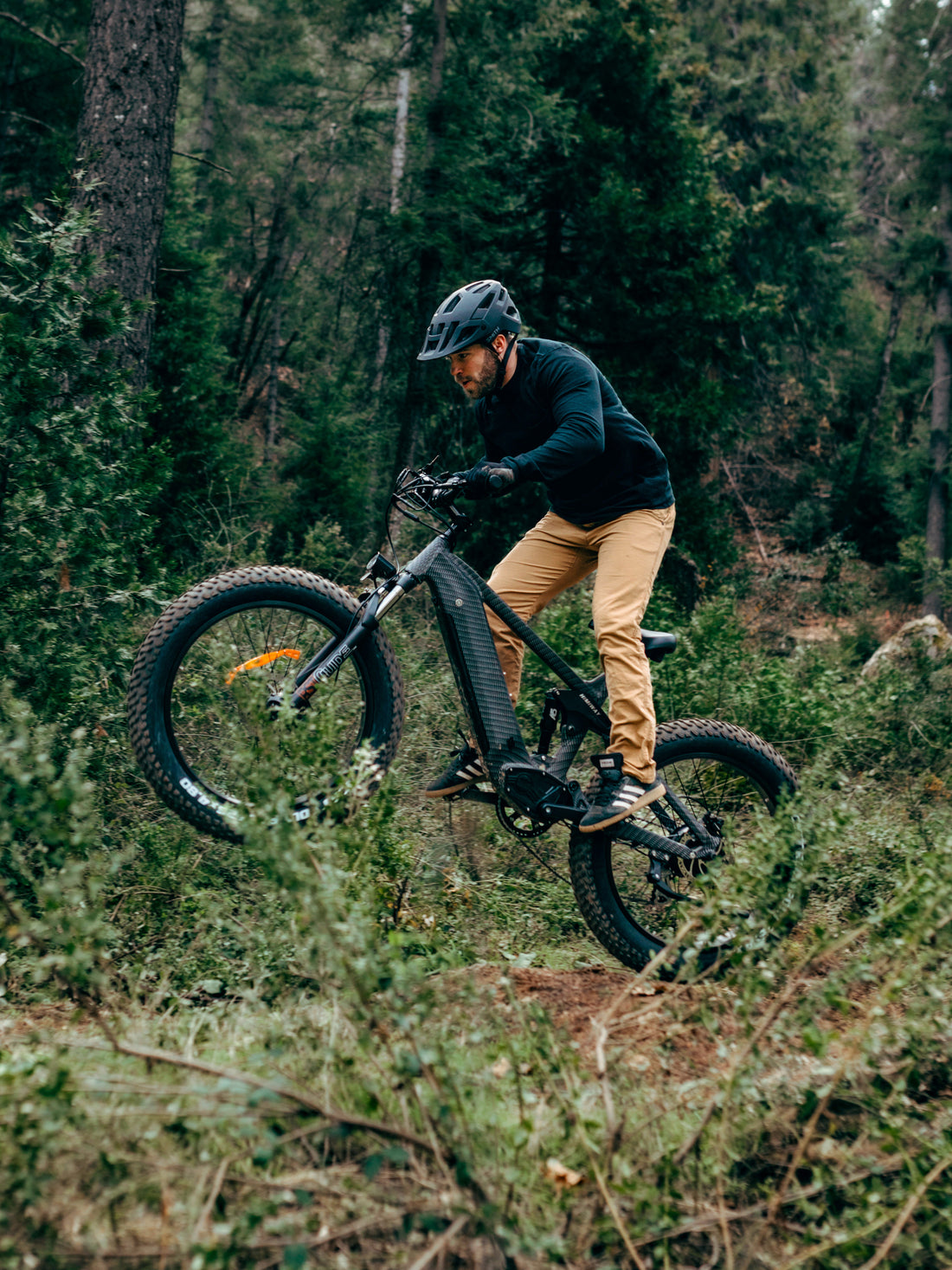
Best eBikes for Active Seniors

Best eBikes for Active Seniors

1000+Shop

2-Year Warranty

15-Day Trial

Free Shipping

Best eBikes for Active Seniors: More Trail, Less Effort, Same Adventure

This guide is for riders 60–80+ who are still active and want to stay that way. The questions answered here are the ones seniors actually ask — about safety, weight, joint comfort, hills, repairs, and whether an e-bike will make riding more enjoyable or just more complicated.

What Active Seniors Actually Need in an eBike

🛡️ Safe Entry, Confident Stopping

  • Step-through or low-standover frame — no leg swing, both feet flat at stops
  • Hydraulic disc brakes with motor cut-off — consistent stopping power in rain, downhill, and emergency situations
  • Fat tires (4.0") or wide hybrid tires (2.4") — wider contact patch for stability on gravel, wet pavement, and uneven surfaces
  • Walk mode — push the bike slowly with motor assist without pedaling or riding
  • Low center of gravity — reduces tip risk at slow speeds and stops

🦴 Joint-Friendly Performance

  • Full suspension — 90–130mm rear travel absorbs bumps before they reach your spine, hips, and wrists
  • Wide memory foam saddle (220mm+) — reduces tailbone and sit-bone pressure on longer rides
  • 0–60° adjustable stem — upright riding posture reduces neck and lower back load
  • Torque sensor + Auto Assist — motor matches your effort automatically, no sudden lurching
  • 5-level assist — dial in the exact effort level your body allows on any given day

🗺️ Range That Opens Up New Routes

  • 65–70 mile range — covers 3–4 hour trail rides with assist to spare
  • 750W 70–90Nm motor — climbs 15–20% grades without struggle, so hills stop being a deterrent
  • Removable battery — charge it indoors without moving the bike; no garage wiring needed
  • Integrated LED lighting — early morning and evening rides stay visible and safe
  • 400–440 lb payload — accommodates heavier riders and loaded panniers without power loss

Top eBike Picks for Active Seniors

🏆 Best for Trails & Mixed Terrain

Himiway D5 2.0 ST eBike

The most capable step-through e-bike for seniors who ride beyond pavement. A 19.3" standover height means stepping through to mount — no leg lift, no balancing act. Full suspension (100mm front + 130mm rear) handles park trails, gravel paths, and unpaved rail trails. The 90Nm torque sensor-based motor reads your pedal effort and amplifies it smoothly — no sudden power surge when you start from a stop. MIK rear rack for panniers and baskets. Rider height 5'1"–6'5".

Motor: 750W / 90Nm  |  Range: 65 mi
Suspension: Full (100mm front + 130mm rear)
Tires: Maxxis 26×4.0"  |  Payload: 400 lb
Standover: 19.3"  |  Brakes: Tektro hydraulic
View Bike →

🌟 Lightest Step-Through, Longest Range

Himiway D5 2.0 20" eBike

At 80 lbs — 12 lbs lighter than the 26" models — the D5 2.0 20" is the most manageable full-suspension e-bike in the lineup. The 17" standover height is the lowest of any D5 model, fitting riders from 4'11". Its 70-mile range (highest in the D5 family) and 440 lb payload make it the most practical choice for seniors who prioritize easy handling and long-distance rides over maximum off-road capability. Full suspension keeps it smooth on rough park paths. Rider height 4'11"–6'2".

Motor: 750W / 90Nm  |  Range: 70 mi (highest in family)
Suspension: Full (90mm front + 100mm rear)
Tires: Kenda 20×4.0"  |  Payload: 440 lb
Weight: 80 lb  |  Standover: 17"
View Bike →

🏙️ Best for Comfort on Paved Trails & Scenic Routes

Himiway A7 Commuter eBike

Purpose-built for comfortable distance riding on paved and packed-gravel paths. The 220mm memory foam saddle is the widest in the Himiway lineup — a meaningful difference on 2+ hour scenic rides. Full suspension (120mm front + 90mm four-link rear), 2.4" tires, and an upright riding position address the three most common senior complaints: saddle soreness, back pain, and neck strain. MIK HD rear rack (60 lb rated) supports panniers and rear baskets for errands and day trips. Available in Regular (5'1"–6'3") and Large (5'3"–6'1") frames.

Motor: 750W / 70Nm  |  Range: 65 mi
Suspension: Full (120mm front + 90mm four-link rear)
Tires: Innova 27.5×2.4"  |  Payload: 400 lb
Saddle: 220mm memory foam  |  Rack: MIK HD (60 lb)
View Bike →

Frequently Asked Questions

The real questions active seniors ask before buying their first — or next — e-bike.

Am I the Right Rider for an eBike?

I haven't ridden a bike in years. Will I actually be able to get back into it on an e-bike?

Yes — and e-bikes are specifically why many seniors who had stopped cycling entirely are riding again. The motor removes the barriers that stopped people from riding: hills that were too steep, headwinds that were too exhausting, distances that were too discouraging. On an e-bike, those obstacles become manageable.

What experienced returning riders consistently report:

  • Muscle memory returns quickly — balance, steering, and braking feel familiar after 2–3 short rides. The e-bike's weight actually helps here: a heavier bike is more stable and tracks straighter at low speeds than a light road bike
  • The motor is supportive, not overwhelming — in Assist Level 1 or 2, the motor adds a gentle push when you pedal, not an uncontrollable surge. You still pedal; you just don't have to pedal hard
  • Start shorter than you think — a 20-minute neighborhood loop is a completely reasonable first ride. Most riders who do this end up going farther within a week
  • Take it to a flat empty space first — a parking lot or quiet park path is ideal for the first 30 minutes: start, stop, turn, start again. Getting comfortable with the motor response before adding hills or traffic makes a real difference

One consistent finding: 63-year-olds who bought an e-bike "for occasional use" frequently ride far more than they expected. Riding stops feeling like exercise and starts feeling like going somewhere.

Related: Complete guide to e-bikes for seniors

I'm 70+ and still active — will an e-bike keep me active, or make me lazy?

This concern comes up often, and the evidence consistently points one direction: e-bike riders exercise more than non-assisted cyclists, not less.

The reason is straightforward. On a regular bike, a steep hill means you either stop, walk the bike, or suffer through it — all of which discourage future rides. On an e-bike, you choose your effort level. A 72-year-old who rode 7,600 miles in three years on an e-bike summarized it this way: "I pedal it more than I use the assist. I use the assist for hills my body can't handle anymore."

  • Assist Level 1 — adds about 40% of your pedal effort. You still work; you just work sustainably. Most riders in decent shape use Level 1 on flat terrain
  • Assist Level 3 — the everyday moderate setting for most riders. Lets you cover 15–20 miles without exhaustion
  • Assist Level 5 — saves you for the hard parts: steep hills, headwinds, or when your knees are having a rough day. Using Level 5 on a tough climb doesn't make the rest of the ride "lazy"

The real benefit for active seniors: e-bikes let you maintain the habit of going out on days when your body would have kept you home. Consistency over months matters far more than effort level on any given ride.

Guide: E-bikes for seniors with balance challenges

I have knee arthritis. Is cycling on an e-bike actually good for me, or will it make things worse?

Cycling is one of the most joint-friendly forms of exercise available — the circular pedaling motion strengthens the muscles around the knee without the impact loading of running or hiking. E-bikes specifically improve on this for arthritic riders in several ways:

  • Motor takes over at high-resistance moments — the start from a dead stop and the push over a hill crest are when knee load is highest. With motor assist, those moments require less force through the joint
  • Maintain momentum — the motor helps you keep moving at consistent speed rather than surging and stopping. Consistent, smooth circular motion is better for arthritic joints than variable, grinding effort
  • Cadence mode option — in cadence-based assist, the motor activates when the pedals turn. You can spin at low resistance (protecting the knee) while the motor provides the actual forward power
  • Ride further at lower intensity — two shorter, moderate rides per week are generally better for arthritic joints than one exhausting ride that leaves you sore for days

Important: "no impact" doesn't mean "no risk." Riders with severe arthritis should confirm appropriate exercise types with their doctor before starting. That said, low-resistance cycling on a well-fitted e-bike is among the most commonly physician-recommended exercises for knee osteoarthritis.

Full guide: Best e-bikes for arthritis — complete buyer's guide | Arthritis-friendly e-bikes collection

Which Features Matter Most for Senior Riders?

Why is a step-through frame so important — and does it make the bike less capable?

For senior riders, the step-through frame addresses the single most common injury scenario in e-bike accidents: failing to clear the top tube while dismounting. The mechanism is simple — an e-bike weighs 80–92 lbs. If your leg catches the frame while stepping off, the bike doesn't move easily. You do.

What a step-through frame changes practically:

  • No leg swing required — you approach from the side, hold the handlebars, and step through the low opening. The same motion every time, even when you're tired or your hip flexibility isn't what it was
  • Both feet flat on the ground first — you establish footing before committing to the dismount. Critical if you're stopping on a slope or uneven surface
  • Emergency stops are safer — if you have to brake hard and stop suddenly, the step-through exit is available instantly without planning

Does it compromise capability? The D5 2.0 ST has identical motor, battery, suspension, and tire specs to the high-step D5 2.0 — the frame shape is the only difference. For recreational trail riding, park paths, and scenic routes (the primary active senior use cases), the performance is identical. The step-through frame only shows any structural limitation at very aggressive mountain biking — which is outside the scope of these bikes regardless of frame type.

Related: Step-over vs step-through: which frame is right for you? | Step-through bikes for seniors collection

What's the difference between torque sensing and cadence sensing — and which is better for older riders?

This technical difference has meaningful real-world consequences for senior riders and is worth understanding clearly.

Cadence sensor — detects whether the pedals are turning. When they are, motor power switches on. This can feel abrupt: start pedaling and the motor engages immediately with a fixed power level. Multiple Reddit users who've recommended e-bikes to seniors specifically warn about cadence sensor bikes: "there's a much less chance of getting hurt by accidentally applying too much throttle [or assist]" with torque sensing.

Torque sensor — detects how hard you're pressing on the pedals. Motor output scales proportionally to your actual effort. Push gently, get gentle assist. Push harder on a hill, get stronger assist automatically. The ride feels like a natural, proportional extension of your own pedaling — not like a switch flipping on and off.

For senior riders specifically, torque sensing provides:

  • No sudden acceleration — particularly important if your balance or reaction time is slightly slower than it used to be
  • Predictable behavior in traffic — the motor does what you'd expect it to do based on how you're pedaling, not what gear-change or cadence threshold you crossed
  • Auto Assist mode (available on D5 2.0 series) takes this further — the system automatically selects the assist level based on your riding conditions, so you can focus on riding rather than managing settings

All three recommended bikes here (D5 2.0 ST, D5 2.0 20", A7) support torque sensing. It is one of the most underrated features in senior e-bike selection.

Front suspension only, or full suspension — does it actually matter for a 65-year-old back?

For senior riders, the answer is unambiguous: full suspension (front AND rear) meaningfully improves comfort and reduces spinal load compared to front suspension only (hardtail).

Here's why the rear shock matters specifically for older riders:

  • Where the impact goes on a hardtail — a pothole hit on a hardtail travels from the rear wheel, through the rigid frame, directly up the seatpost into the rider's pelvis and spine. The front fork absorbs front-wheel hits but doesn't protect from rear-wheel impacts at all
  • Where the impact goes on a full suspension bike — the rear shock (90–130mm travel) absorbs that same pothole hit before it reaches the frame. What the rider feels is a smooth compression and rebound, not a jolt
  • Cumulative benefit on longer rides — over a 20-mile ride with hundreds of small road imperfections, the difference between hardtail and full suspension accumulates significantly. Riders with any lumbar or disc sensitivity often find hardtail bikes limit their ride time to 30–45 minutes; the same riders on full suspension bikes frequently ride 90+ minutes without back fatigue

The "good enough" case for hardtail: if you ride exclusively on smooth, well-maintained pavement or paved bike paths without expansion joints, the rear suspension advantage is minimal. For anything else — park trails, gravel paths, older city streets, rural roads — full suspension is the senior-friendly choice.

Technical comparison: Hardtail vs full suspension — the full breakdown

Which Bike Is Right for How You Ride?

I want to ride paved scenic trails, rail trails, and flat park paths. Which bike fits best?

For paved and packed-gravel trail riding as your primary use, the A7 is the most purpose-matched option in the lineup.

Why the A7 works especially well for scenic trail riding:

  • 27.5" × 2.4" tires — faster-rolling on pavement than fat tires, with enough width to handle light gravel and occasional grass without concern
  • Upright riding position — the adjustable stem + wide, swept-back bars let you sit tall and look around comfortably while riding. You're there for the scenery, not to get somewhere fast
  • 220mm memory foam saddle — the widest in the Himiway lineup. On 2–3 hour rail trail rides, saddle comfort becomes the limiting factor, not motor range. The wider saddle moves that limit significantly
  • Full suspension — 120mm front fork + 90mm four-link rear keeps the ride smooth over the seams, cracks, and surface variations typical on older rail trails and park paths
  • MIK HD rack — supports panniers for carrying lunch, a jacket, and water — the practical kit for a scenic half-day ride

If your scenic trails occasionally include unpaved sections or forest paths, the D5 2.0 ST's fat tires handle those transitions more confidently than the A7's 2.4" tires. For predominantly paved riding: A7. For mixed paved/unpaved: D5 2.0 ST.

Browse: Best e-bikes for long distance touring

I want to do light trail riding — gravel roads, packed dirt, rail trails, some unpaved park paths. Which is best?

For mixed-surface active senior riding — the kind of riding where you start on pavement, transition through a gravel section, cross a packed dirt trail, and end up on a park path — the D5 2.0 ST is the right recommendation.

  • Maxxis Minion 4.0" fat tires — handle the full range of surfaces without requiring tire changes or pressure adjustments. On gravel and packed dirt at 15–18 PSI, they're stable and grippy; on pavement at 22–25 PSI, rolling resistance is manageable
  • Full suspension (100mm front + 130mm rear) — absorbs trail-specific impacts that the A7's smaller tire profile would transmit through
  • 90Nm torque — the extra torque over the A7's 70Nm makes meaningful difference on inclines, particularly when those inclines are unpaved. Gravel and dirt hills require more torque than smooth pavement at the same grade
  • Step-through frame at 19.3" standover — still accessible regardless of where you're mounting (at a trail head, on an incline, near a curb)

The D5 2.0 20" is worth considering if trail-specific capability is less important than easy handling: at 80 lbs and with a 17" standover, it's easier to manage on vehicle transport and in tight trail head parking areas, while still performing well on light mixed terrain.

Guide: D5 2.0 all-terrain riding guide | Off-road e-bikes for adults

My partner and I want to ride together. Should we get the same bike, or different models?

The most common senior couple e-bike scenario: one partner wants step-through and one prefers high-step, or they have different riding styles (one more trail-oriented, one more comfort-focused). Here's how to think through it:

Same bike (D5 2.0 + D5 2.0 ST): The D5 2.0 and D5 2.0 ST have identical performance — same motor, same suspension, same battery, same range. One partner gets the step-through (ST) and the other gets the high-step. You share spare parts, the same charging system, and the same maintenance knowledge. Recommended if you ride the same routes and terrain.

Mixed pairing (A7 + D5 2.0 ST): If one partner wants primarily paved rail trail comfort and the other wants mixed terrain capability, different models serve them better than forcing both onto one compromise. The A7 and D5 2.0 ST share the same 48V charging system and UL 2271 battery standard.

Practical consideration — pace: both the A7 (70Nm) and D5 2.0 ST (90Nm) support 20 mph Class 2 speeds. At typical recreational senior paces (10–15 mph), the motor difference doesn't affect relative speed between riders. You'll comfortably ride together regardless of which models you choose.

See also: eBikes for couples and families

Practical Questions — Weight, Range & Repairs

These bikes weigh 80–92 lbs. How do seniors manage loading them onto a car for trail rides?

Weight is the most consistently cited concern for senior e-bike buyers — and the practical solutions are well-established.

  • Hitch-mounted bike rack — the most senior-friendly vehicle loading option. Hitch racks (1.25" or 2" receiver) support the bike from below with a wheel tray — you roll the bike up the tray and strap it in, no lifting required. Look for racks rated 100 lbs per bike position (most heavy-duty hitch racks). This completely eliminates the lifting problem for most loading scenarios
  • Remove the battery before lifting — the D5 2.0 / D5 2.0 ST battery weighs approximately 12–15 lbs and removes in seconds. Removing it before any lifting reduces bike weight to the 67–80 lb range, which is more manageable
  • Walk mode — hold the walk mode button and the motor pushes the bike up a ramp, into a garage, or onto a trailer at under 4 mph without you needing to provide force. This is underused but transformative for seniors who need to manage the bike on foot
  • D5 2.0 20" is the lightest option — at 80 lbs (vs 92 lbs for 26" models), it's 12 lbs lighter throughout every handling scenario. For seniors where bike weight is a primary concern, the 20" model is the recommended choice without giving up full suspension or step-through access

Roof rack loading (90 lb bike overhead) is not a recommended approach for most senior riders regardless of fitness. Hitch rack or trailer loading is the practical standard.

How far can I actually go, and what happens if I misjudge the range and the battery dies?

Real-world range depends heavily on terrain, assist level, rider weight, and temperature — but here are grounded estimates for active senior riding patterns:

  • Flat paved rail trail at Assist Level 2–3, 160 lb rider: expect 45–55 miles from the D5 2.0 ST or A7, 55–65 miles from the D5 2.0 20"
  • Mixed terrain with hills at Assist Level 3–4, 180 lb rider: expect 30–45 miles depending on grade frequency. The 720Wh battery handles a 3-hour moderate trail ride comfortably
  • Heavy assist (Level 4–5) on hilly terrain: 20–30 miles. Plan for shorter out-and-back routes if your route has sustained climbs

If the battery actually runs out mid-ride: the bike still operates as a conventional pedal bike. At 80–92 lbs, pedaling without assist is hard work — but it's not impossible on flat terrain. For a mile or two to reach a rest stop or parking area, most riders manage it. The throttle also provides a brief burst mode that can cover short distances even when the battery is nearly depleted.

Practical range management: the LCD display shows battery percentage in real time. Turn around when the display hits 40–50% on unfamiliar routes — this gives generous reserve for the return leg and unexpected detours. The 65–70 mile rated range means most senior day rides of 20–30 miles leave substantial buffer.

Battery care: Maximizing your e-bike battery lifespan

Parts support and repairs — what happens if something goes wrong two years from now?

This is one of the most important questions to ask before any e-bike purchase, and it's worth being direct about the landscape.

  • 2-year warranty — all Himiway bikes carry a 2-year warranty on frame, motor, battery, and electrical components. This is among the stronger warranties in the direct-to-consumer e-bike market
  • 1,000+ authorized service shops across the US — Himiway's US service network means local shop service is available in most areas. The Shimano drivetrain components (cassette, chain, derailleur) used on these bikes are the industry standard — any local bike shop can source and install Shimano parts regardless of whether they're an authorized dealer
  • Tektro brakes and RST/SR-Suntour suspension forks — these are mainstream components, not proprietary parts. Brake pads, cable sets, and fork service are available at bike shops nationwide
  • Battery longevity — the 48V lithium-ion batteries are rated for 800+ charge cycles. At one full charge per week, this is 15+ years of weekly riding. For most seniors doing 50–100 miles per week maximum, battery degradation is rarely the limiting factor within the 5–7 year planning horizon
  • Firmware and display updates — the Bluetooth-connected display on D5 2.0 models allows over-the-air software updates, addressing software-related performance issues without a shop visit

The one honest caution: like all direct-to-consumer brands, motor and battery proprietary components (not standard bike components) are sourced through Himiway directly if replacement is ever needed. This works well when the company is established — which Himiway, founded in 2017 with global distribution, currently is.

Safety, Confidence & the First Ride

I have mild balance challenges. Will fat tires actually make a meaningful difference?

Yes — and for riders with any balance sensitivity, fat tires are one of the most meaningful stability upgrades available on an e-bike.

The physics: a wider tire has a larger footprint on the ground. At the same lean angle, a fat tire (4.0") provides more resistance to tipping than a narrow tire (2.4") because it's supporting a larger area. At very low speeds — the speeds where balance challenges most often appear — this difference is pronounced.

  • At stops — fat tires maintain contact over a wider area when you slow to 1–2 mph, making the last few feet before stopping more forgiving of slight lean
  • On gravel and grass — fat tires "float" over loose or uneven surfaces rather than tracking in ruts. This matters for riders who need to put a foot down on mixed-surface terrain
  • Low tire pressure option — running 15 PSI on fat tires creates a self-correcting contact patch that subtly resists lean, similar to training wheel physics but without actual training wheels

Important context: fat tires address balance at slow speeds and on varied surfaces. They don't replace the need for basic cycling balance skills. Riders with significant balance impairments should consider a three-wheel e-bike (tricycle) rather than a two-wheel e-bike of any tire width.

Related: Best e-bikes for seniors with balance concerns

What does UL 2271 battery certification mean, and why does it matter when I'm storing a bike at home?

UL 2271 is the most rigorous independent safety standard for e-bike batteries, tested by Underwriters Laboratories (the same organization that certifies home appliances). It matters for senior riders specifically because:

  • Thermal runaway prevention — UL 2271 tests require the battery management system to shut down safely under overcharge, over-discharge, short circuit, and thermal stress conditions. Batteries that fail these tests cannot carry the certification. Uncertified batteries have been involved in the majority of residential e-bike fires
  • Apartment and garage charging — many senior living communities, apartments, and condominiums with fire safety rules require UL-certified batteries for indoor charging. UL 2271 certification typically satisfies these requirements
  • What it covers: the D5 2.0 / D5 2.0 ST / D5 2.0 20" batteries carry UL 2271 certification. The battery management system monitors cell temperature, charge rate, and discharge in real time — automatically cutting power if any parameter exceeds safe limits
  • Practical charging guidance: charge the battery at room temperature (not a hot garage in summer or cold storage in winter), don't leave on the charger for more than 24 hours after full charge, and use only the included charger. These habits maintain both battery longevity and safety simultaneously

Browse: UL certified e-bikes collection

What are the most important things to do before my first ride to make it go well?

A 20-minute preparation before the first ride eliminates most of the small friction points that trip up new e-bike riders:

  • Set seat height correctly — when seated, your knee should have a slight bend (not fully extended) at the bottom of the pedal stroke. A properly fitted seat dramatically improves pedaling efficiency and knee comfort. Most seats adjust with a quick-release lever — no tools
  • Adjust the stem angle — the 0–60° adjustable stem on D5 2.0 models lets you raise the handlebars to an upright, comfortable position. Don't ride hunched over on the first ride because the stem is in a low position from shipping
  • Start in Assist Level 1 or 2 — not Level 5. Understand what the motor response feels like on gentle, flat terrain before adding more power or hills. 15 minutes in Level 2 is enough to get a feel for the system
  • Locate the throttle and understand it's an override — the thumb throttle provides instant motor power independent of pedaling. Know where it is, don't accidentally activate it while learning, and understand you can use it deliberately whenever you need a burst of power
  • Check tire pressure — bikes ship at moderate pressure that may not match your terrain. 20–22 PSI for mixed terrain; 15–18 PSI for gravel and trails; 22–25 PSI for pavement. A floor pump with gauge takes 2 minutes
  • Wear a helmet — e-bikes reach 20 mph. The only non-negotiable preparation item

Full checklist: E-bike safety checklist for every ride

Why HIMIWAY ?

Ride Further Together

491 K+

Himi Riders
Recognition from knights around the world

15 K+

5-Star Reviews
The knights give an honest opinion

1200 +

Professional Review
What the professional media really thinks of us

Local Shop

Learn More

2-Year Warranty

Learn More

15-Day Trial

Learn More

Free Shipping

Learn More

Bikes for Every Ride

Explore our diverse lineup designed to fit every rider and terrain

Mountain eBike

Kids eBike

City eBike

Cargo eBike

Folding eBike

Find a Local Himiway Shop Near You

Looking for a hands-on experience?
Find a Himiway electric bike shop near you and schedule a test ride today.