



The best camping e-bike is the lightest model that safely handles your route, cargo, and transport setup. Paved RV parks may suit a compact commuter. Rough forest roads may need wider tires, stronger brakes, and suspension. Before buying, compare bike weight, payload, rear-rack capacity, loaded range, and charging access. Choose for the hardest required section, not an imagined off-road adventure.
What Type of Camping E-Bike Do You Need?
Start with four questions. Where will you ride? How far is the longest required trip? What will the bike carry? How will you transport it? A paved campground may suit a compact commuter. Rough forest roads may justify wider tires, stronger brakes, and more suspension.
| Camping use | Likely route | Useful bike traits | Main trade-off |
|---|---|---|---|
| RV campground errands | Pavement and packed campground roads | Easy storage, manageable weight, removable battery | A large all-terrain bike may be harder to lift and store |
| Car camping with local rides | Pavement, maintained gravel, mild hills | Stable tires, reliable brakes, rack mounts | Extra suspension and tire width may add weight you do not need |
| Forest-road basecamp | Washboard, loose gravel, roots, longer climbs | Route-matched tires, low gearing, strong brakes, suspension | Heavy bikes are harder to load and move without power |
| Sand or snow access | Soft surfaces where tires sink | Fat tires that support lower approved pressure | More rolling resistance and bulk on firm roads |
Camping is not the same as bikepacking. A camping e-bike usually returns to a vehicle or fixed basecamp. Bikepacking requires the bicycle to carry your overnight system between camps.
Use the least complicated bike that clears the route
A lighter commuter can be the better camping bike on pavement. A hardtail can handle maintained forest roads. Full suspension and fat tires become useful when the ground actually calls for them.
Can Your Current E-Bike Handle a Camping Trip?
It may work if the route fits its tires, brakes, range, and approved load. Test it with your planned cargo before buying another bike. Stop if bags touch moving parts or braking feels weak. Choose another route when lifting, pushing, or repairing the loaded bike exceeds your ability.
A city e-bike does not fail simply because it reaches a campground. Many campsites have paved roads and short trips into town. Trouble starts when the route and bike no longer match.
Run a loaded practice ride
- Pack the same water, locks, tools, and bags you will carry.
- Ride a hill and surface similar to the camping route.
- Test slow turns, hill starts, and firm controlled braking.
- Measure battery use instead of relying on advertised maximum range.
- Push the bike without power and practice loading it onto your vehicle.
This test answers more than a specification sheet. It shows whether the bike is stable, repairable, and practical for your transport setup.
Which Camping E-Bike Specifications Matter Most?
Prioritize transport weight, rider fit, tires, brakes, battery energy, and approved cargo limits. Motor power matters, but one torque number cannot describe every climb. A heavy specification can solve rough terrain and create a loading problem. Judge the complete system against your actual campsite and vehicle.
Transport weight and dimensions
Measure your storage space and vehicle rack. Read its limits for total weight, each bike, tire width, and RV use. Make sure you can lift the bike safely.
Rider fit and frame access
Rider-height guidance and standover height show how the frame may fit. A step-through frame can make mounting easier when bags occupy the rear rack.
Tires and suspension
Wider tires allow lower approved pressure on soft ground. Suspension can improve control on repeated impacts. Neither feature is mandatory for smooth campground roads.
Brakes and service parts
Loaded bikes need dependable braking. Fresh pads, sound rotors, and suitable tire pressure matter. Carry parts that fit your exact wheel and drivetrain.
Which motor setup is easier to live with at camp?
Repair access matters more than a motor label at camp. A hub motor makes the rear wheel heavier to remove. A mid-drive sends power through the chain and gears. That makes drivetrain condition more important.
Choose a system you can service along the route. The hub-motor versus mid-drive guide explains the architectures without turning this camping guide into another motor comparison.
Which suspension fits basecamp life?
Full suspension can help on repeated roots, rocks, and washboard. It also adds weight and moving parts. A hardtail leaves a simpler rear frame for cargo and service.
Compare both designs in the hardtail versus full-suspension guide. Do not assume a rear shock increases the rack's approved load.
How Do Payload and Rack Limits Work?
Payload is the total approved load carried by the bike. It usually includes the rider and cargo. The rear rack has its own smaller limit. Your vehicle rack uses a third limit for bike transport. Every number must pass independently. The largest rating does not override the others.
Picture the bike beside your RV. The vehicle rack may support the bike while the rear rack still limits your cooler. Those numbers answer different questions.
Keep the ratings separate: a 400 lb bike payload does not mean the rear rack can hold 400 lb. It also says nothing about your vehicle rack.
This distinction is especially important when shopping for an electric bike for 400 lb person. A 400 lb total payload rating does not automatically mean the bike is approved for a 400 lb rider, because the manufacturer may specify a lower maximum rider weight and reserve part of the payload for cargo. Check the rider limit, total payload, rear-rack capacity, and any transport-rack limits separately to make sure every component can safely handle the intended load.
Use simple load math
Add your body weight, clothing, water, tools, bags, locks, and every carried item. Compare that total with the bike's payload limit. Then weigh only the cargo placed on the rear rack.
Bag position matters after the numbers pass. Keep dense items low and balanced. Keep straps away from wheels, brakes, cables, suspension, and battery access.
How Much Battery and Charging Do You Need?
Plan from your longest required ride, not the battery's maximum claim. Test the loaded bike on similar ground and keep a reserve. Match each source to the supplied charger. Is the outlet permitted and dry? Is enough usable energy available? Can it power the charger long enough?
| Charging option | When it fits | What matters |
|---|---|---|
| Campground outlet or RV shore power | Established sites with confirmed electricity | Permission, outlet condition, weather protection, charging location |
| RV house battery and inverter | The RV electrical system supports the charger | Usable energy, inverter output, wiring limit, RV manual |
| Portable power station | Basecamp charging away from a fixed outlet | Usable AC watt-hours, continuous output, conversion losses |
| Compatible spare battery | A route exceeds the tested single-battery plan | Exact system approval, protected storage, added weight |
| Solar feeding a power station | Stationary camp has enough sun and setup time | Panel input, weather, daylight, storage, conversion equipment |
If your loaded test shows a real range gap, the current D5 2.0 Series 7th Anniversary offer includes a free second 15Ah battery.
What does a 720Wh battery mean for a power station?
Watt-hours, or Wh, show stored energy. A 720Wh e-bike battery needs more than a 720Wh label on the power station for a full recharge. Some stored energy is unavailable or lost during conversion.
Compare the station's usable AC energy with the recharge you actually need. Its continuous AC output must support the supplied charger. Try the complete setup at home.
UL Solutions advises using the battery and charger supplied with the device. Its micromobility charging guidance also warns against unapproved aftermarket batteries and chargers.
Keep charging equipment dry, uncovered, and away from flammable material. The e-bike battery maintenance guide covers storage and temperature basics.
Where Can You Legally Ride a Camping E-Bike?
Access depends on the land manager, route designation, e-bike class, and local rule. A campsite map does not prove that a nearby trail allows your bike. Look up the exact road or trail before riding. Review it near departure because closures and policies can change.
| Land or route | General starting point | Where to look |
|---|---|---|
| National Park Service | Superintendents may allow e-bikes where traditional bicycles are allowed and may add conditions | NPS e-bike guidance and the specific park page |
| Bureau of Land Management | Allowed on routes open to motorized or OHV use; non-motorized access needs a local written decision | BLM e-bike program and local field office |
| National forests and grasslands | Classes 1, 2, and 3 are allowed on motorized roads and trails; other access needs local designation | U.S. Forest Service e-bike guidance and local travel map |
| Designated Wilderness | E-bikes are not allowed | Agency map, wilderness boundary, and local office |
State definitions and equipment rules also vary. Start with the PeopleForBikes state-law resource, then read the local access rule.
A class setting is not a universal access pass
Changing an enabled mode does not guarantee that a land manager will treat the bike as another class. Read the class label, equipment, operating mode, and local wording together.
The three-class e-bike guide explains the common Class 1, 2, and 3 framework. Local law still controls the route.
How Does the Himiway D5 2.0 Fit Camping?
The D5 2.0 series fits basecamp riders who need fat tires, full suspension, hydraulic brakes, and substantial payload room. It is less suitable when frequent lifting is unavoidable. The 26-inch versions weigh 92 lb with the battery. The 20-inch version weighs 80 lb and does not fold.
| Model | Camping Specs | Best fit | Consider |
|---|---|---|---|
| D5 2.0 26-inch | 720Wh, 65-mile pedal-assist claim, 400 lb payload, MIK rack system | Rough campground and forest-road rides | 92 lb bike weight and 27.6-inch standover |
| D5 2.0 ST | Same main specifications as the 26-inch D5 2.0; 19.3-inch standover | Riders who want easier mounting with rear cargo | Still weighs 92 lb with the battery |
| D5 2.0 20-inch | 720Wh, 70-mile pedal-assist claim, 440 lb payload, 120 lb MIK HD compatible rack | Shorter riders and tighter storage spaces | 80 lb, non-folding frame still needs a suitable vehicle rack |
| D5 2.0 Camo | Same main specifications as D5 2.0 ST; 120 lb rack capacity and documented towing capability | Fishing, hunting, and gear-focused outdoor trips | Use only approved towing equipment and follow every component limit |
Published range is a starting specification, not your camping mileage. Cargo, grade, soft ground, wind, temperature, assist level, and tire pressure change energy use.
The 400 lb or 440 lb payload includes the rider and cargo. It does not transfer to the rear rack or your vehicle rack.
“We use our Himiways on off road fishing trips where the terrain can be quite rough with rocks and small holes.”
— Dave L., verified D5 2.0 Camo buyer, December 2025
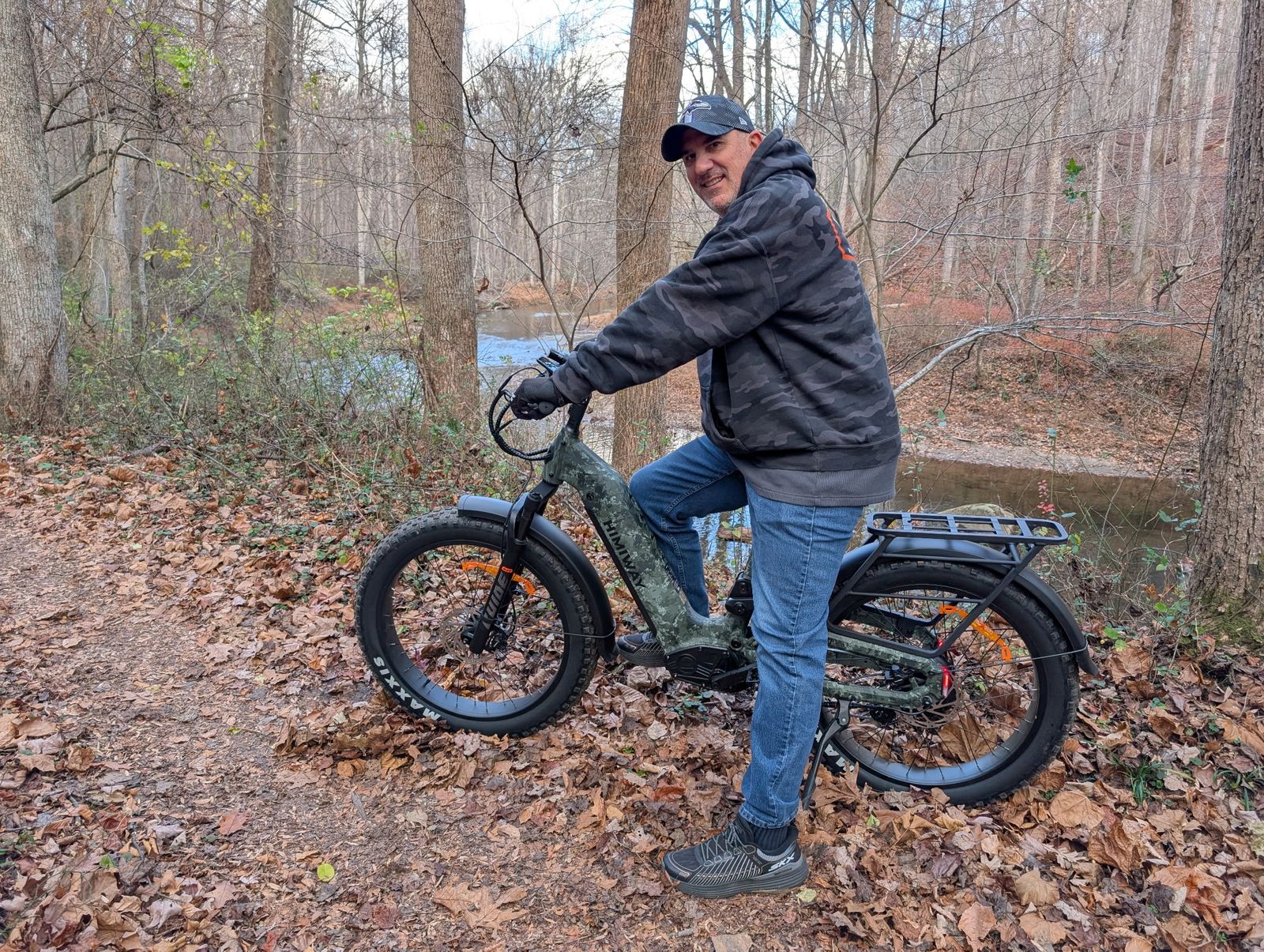
These reports support outdoor fishing, hunting, and trail use. They do not verify camping range, cargo weight, or trailer performance. Try your complete setup before leaving the basecamp.
How Should You Prepare Before Leaving Camp?
Give yourself five calm minutes before riding. Review the route, weather, battery, tires, brakes, bags, tools, and return point. Save maps and contacts offline. Tell someone when you expect to return. This short routine protects the day without turning camp into a technical project.
- Know the exact route and current e-bike access rule.
- Set a turnaround time and battery level before departure.
- Set tire pressure within the tire and bike guidance.
- Test both brakes and inspect pads, rotors, and levers.
- Secure bags and keep straps away from every moving part.
- Carry a compatible tube, pump, tire tools, and wheel tools.
- Save the campground, ranger office, bike shop, and pickup contacts.
- Lock the bike whenever it is outside your direct control.
What Else Should Campers Know About E-Bikes?
Do you need fat tires for camping?
No. Fat tires help when lower approved pressure is useful on sand, snow, or loose ground. They add width and weight.
Pavement and maintained gravel may suit a lighter tire. Choose for the hardest surface you must ride.
Can you carry an e-bike on an RV bike rack?
Only when the rack maker approves the mounting location and bike weight. Read the total capacity, per-bike limit, tire width, and wheelbase.
A rack approved for a car may not be approved behind an RV or travel trailer.
Should you remove the battery during vehicle transport?
Follow the bike and vehicle-rack manuals. Removing the battery can reduce lifting weight. Protect the removed pack from impact, metal objects, moisture, and extreme temperatures.
Can you leave an e-bike battery inside a hot or cold RV?
Use the storage limits in the battery manual. A closed vehicle can expose the pack to temperatures outside those limits.
Let the battery return to an approved charging temperature before connecting the charger.
Can a portable power station charge an e-bike?
Yes, when its usable AC energy and continuous output support the supplied charger. Include conversion losses in the energy plan.
Test one complete charging cycle at home. Do not judge compatibility from outlet shape alone.
Can you use any electrical outlet at a campground?
No. Ask the campground or property owner first. Use the outlet only with permission and keep the connection dry.
Charge away from flammable material and exit paths. Never charge damaged or wet equipment.
Can a camping e-bike pull a trailer?
Only when the bike maker approves towing for that model and your trailer uses an approved connection. Payload and motor torque do not grant towing approval.
Treat the bike, hitch, trailer, brakes, cargo, and local rule as separate limits.
Are camping e-bikes allowed in designated Wilderness?
No. E-bikes are not allowed in designated Wilderness. Read the boundary carefully because a legal road can approach land where bicycle access ends.
How should you secure an e-bike at camp?
Lock the frame to a fixed object where the campground permits it. Secure removable parts and record the serial number.
Bring the battery inside only when the property and battery storage rules allow it.
Ready to Match an E-Bike to Your Campsite?
Start with your transport limit, hardest legal surface, loaded range, and charging plan. Then compare bikes that meet all four conditions.
Compare camping e-bikes


